Hotels That Never Were: The Lost Las Vegas Resorts That Could Have Changed the Strip Forever
The Lost Las Vegas Resorts That Could Have Changed the Strip Forever
Las Vegas is famous for the hotels it built, demolished, rebuilt and reinvented. Yet some of the most fascinating chapters in the city’s history concern the resorts that never opened at all.
They survive only through architectural renderings, planning applications, newspaper reports, abandoned construction sites and the memories of the developers who believed they could create the next great Las Vegas landmark.
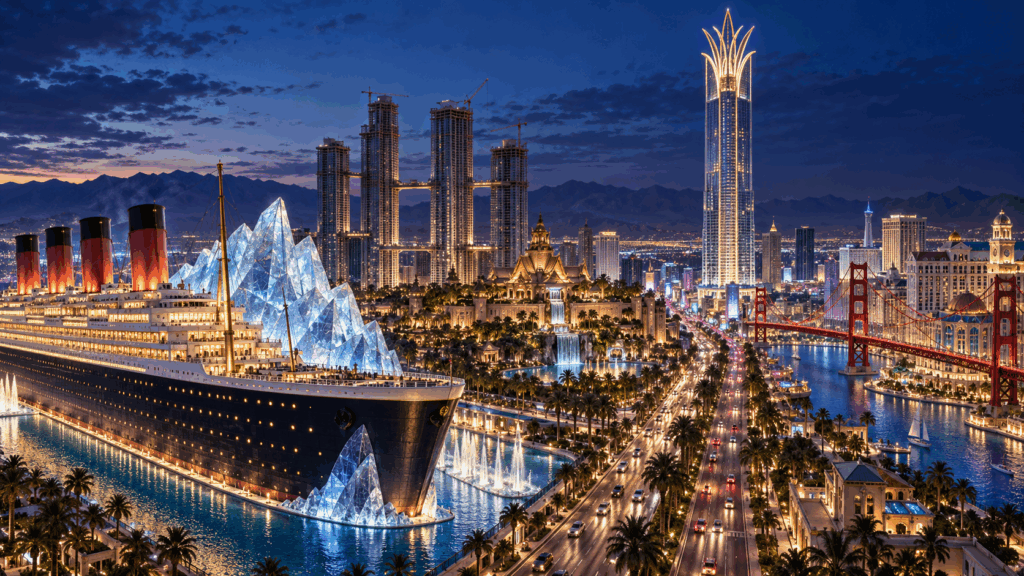
At different points in its history, Las Vegas could have welcomed a colossal Titanic-shaped resort, the tallest hotel tower in the Western Hemisphere, a miniature San Francisco waterfront and a tropical kingdom inspired by Bali. Billions of dollars were proposed, thousands of hotel rooms were announced and extraordinary attractions were promised.
Some projects disappeared before construction started. Others reached the building stage before economic events overwhelmed them. A few were eventually replaced by successful resorts that borrowed something from the original ambition while taking the land in a completely different direction.
These hotels may never have welcomed a single guest, but they still matter. They reveal how Las Vegas is imagined, financed and continually remade—and how the difference between a Strip icon and an empty lot can come down to timing, funding, politics and public confidence.
Las Vegas Has Always Been Built on Audacious Ideas
Almost every famous Las Vegas resort sounded improbable before it existed.
A hotel shaped like a pyramid? An artificial volcano erupting outside a casino? A recreation of Venice complete with canals and gondolas? A replica of the Eiffel Tower towering over Las Vegas Boulevard?
Each of those ideas crossed the line between fantasy and reality. That history encouraged developers to believe almost anything could work in Las Vegas if it was big enough, distinctive enough and sufficiently well financed.
The city rewards imagination—but imagination alone is never enough.
A major resort must survive land negotiations, zoning hearings, height restrictions, construction costs, changing consumer tastes, economic downturns and the continual challenge of raising capital. A spectacular rendering may capture the public’s attention, but it does not guarantee the money required to pour foundations, build towers and open the doors.
That is why the history of Las Vegas is filled with two parallel skylines.
One is the Strip we know: Bellagio, Caesars Palace, MGM Grand, Wynn, The Venetian, Luxor, Resorts World and Fontainebleau.
The other is an imaginary Strip occupied by casinos that existed only on paper.
These are some of its greatest lost landmarks.
Titanic Las Vegas: The Ship That Never Sailed
Proposed rooms: Approximately 1,200
Estimated cost: Approximately $1.2 billion
Proposed: 1999
Developer: Bob Stupak
Status: Rejected before construction
Of all the unbuilt resorts proposed for Las Vegas, Titanic Las Vegas may have been the most visually unforgettable.
The project was promoted by Bob Stupak, the flamboyant casino entrepreneur associated with Vegas World and the development of the Stratosphere. Stupak was not known for modest ideas. His Las Vegas career was built on spectacle, aggressive promotion and a willingness to propose attractions that more cautious developers might never have attempted.
In 1999, he began promoting a resort inspired by the RMS Titanic.
This was not intended to be a conventional hotel containing a small maritime exhibition. The resort itself would have been a monumental interpretation of the famous ocean liner, accompanied by an enormous artificial iceberg containing hotel accommodation.
Plans reported at the time described approximately 1,200 rooms, extensive public attractions and more than one million square feet of space. Contemporary reports said the recreated vessel would have been significantly larger than the original Titanic. The development was expected to contain a casino, theatre, amusement attractions, nightlife and other entertainment components.
One proposed nightclub reportedly carried the wonderfully unsubtle name “The Ice Breaker.”
There were even reports of a transport connection—sometimes described as a high-speed “Titanic Bullet” train—that could have linked the development with Downtown Las Vegas.
The size of the idea was pure Stupak. Its subject, however, created obvious difficulties.
The Titanic was not a fictional adventure ship. It was the site of a genuine maritime disaster in which more than 1,500 people lost their lives. A casino resort built around that tragedy would inevitably have raised questions of taste, sensitivity and commercial exploitation.
That did not necessarily make the project impossible in late-1990s Las Vegas. This was still the era in which enormous themed resorts competed to deliver the most immediately recognisable fantasy. The Strip already offered ancient Egypt, imperial Rome, medieval castles, tropical islands, New York landmarks and a recreation of Venice.
From a purely visual perspective, a vast ocean liner and iceberg would have fitted into that landscape.
The greater obstacle was securing an acceptable site and obtaining approval.
Stupak considered land around Las Vegas Boulevard and Charleston Boulevard, close to established residential neighbourhoods. Local opposition was considerable, and the Las Vegas City Council declined to approve the project. UNLV’s Bob Stupak archive confirms that the Titanic resort was ultimately rejected by the council. UNLV Special Collections
The plan consequently sank before construction began.
Would Titanic Las Vegas Have Worked?
It would almost certainly have become one of the most photographed structures in the city. Few buildings could have competed with the immediate visual impact of a giant ocean liner apparently stranded in the Nevada desert.
Whether it would have succeeded as a resort is a different question.
The concept might have attracted enormous initial curiosity, but heavily themed properties must remain convincing after the novelty fades. A theme that is immediately recognisable can also become restrictive. Every restaurant, room, attraction and entertainment venue must either support the story or fight against it.
There was also the unavoidable association with disaster. Luxor later demonstrated that the Titanic story could support a serious and commercially successful exhibition without turning the entire resort into an interpretation of the ship.
Visitors who remain fascinated by the vessel can still experience Titanic: The Artifact Exhibition at Luxor, where artefacts and reconstructed environments tell the story in a more historical setting.
Titanic Las Vegas never rose from the desert, but it remains a perfect example of the city’s ability to make even the most improbable proposal feel temporarily possible.
Echelon Place: The Megaresort Interrupted by the Financial Crisis
Announced investment: Approximately $4.8 billion in its expanded form
Planned opening: Originally 2010
Construction began: 2007
Construction suspended: 2008
Former site: Stardust Resort and Casino
What ultimately opened there: Resorts World Las Vegas
Echelon Place belongs to a different category from Titanic Las Vegas.
It was not merely a concept or an artist’s impression. It was a serious, financed resort development on one of the most historically important sites on the Las Vegas Strip. Construction began, structures rose from the ground and the project appeared destined to become one of the city’s next major resort complexes.
Then the global economy changed.
Boyd Gaming announced Echelon as the successor to the legendary Stardust, which closed in November 2006 and was imploded in March 2007. The loss of the Stardust was significant. It had been part of the Strip for almost half a century and remained closely associated with classic Las Vegas.
Its replacement therefore carried enormous expectations.
Echelon was planned as a contemporary mixed-use resort complex rather than a nostalgic continuation of the Stardust. The development was expected to include several hotels, a large casino, extensive convention facilities, theatres, restaurants, nightlife and retail.
Different stages of the proposal produced different room totals, which is why historical summaries sometimes give conflicting numbers. The complete Echelon development was eventually described as having more than 5,000 rooms across multiple hotel brands, although individual parts of the resort were often quoted separately.
The project represented the prevailing theory of mid-2000s Las Vegas development: build an enormous destination combining gaming, accommodation, conventions, retail, food and entertainment, then use each component to support the others.
Construction began during a period of exceptional confidence.
By 2008, that confidence had evaporated.
The global financial crisis damaged credit markets, reduced access to development capital and placed severe pressure on the Las Vegas economy. Visitor spending weakened, property values declined and large construction projects became extraordinarily difficult to finance.
Boyd suspended work on Echelon in 2008. The company initially presented the interruption as a delay, but the unfinished structures remained dormant for years.
The exposed steel and concrete became one of the most prominent symbols of the recession’s impact on Las Vegas. Visitors passing the north Strip could see not just an empty site but the skeleton of the boom that had ended.
In 2013, Boyd sold the site to Malaysia’s Genting Group for $350 million. The abandoned Echelon structures were gradually removed or incorporated into new site preparations, and Genting announced Resorts World Las Vegas.
Resorts World eventually opened in June 2021. The completed development brought multiple Hilton-affiliated hotel experiences, a casino, restaurants, retail, nightlife, a theatre and a substantial pool complex to the former Stardust site.
The Nevada Independent’s account of the development notes that Echelon was originally planned as a $4.8 billion resort before its construction was stopped. The Nevada Independent
Did Echelon Really Fail?
As a specific resort project, yes. Echelon Place was never completed and never opened.
As a vision for the land, however, the story is more complicated.
The idea that the Stardust site could support a multibillion-dollar integrated resort was ultimately proved correct. It was the timing, capital structure and economic environment that failed Echelon—not necessarily the underlying value of the location.
Resorts World is not Echelon under a different name. It has different owners, designs, brands and priorities. Nevertheless, both developments were based on the same fundamental belief: the north Strip could sustain another enormous resort destination.
Echelon reminds us that a good site and ambitious design cannot protect a development from the wider financial system. A resort may be physically located in Las Vegas, but the money required to build it is connected to banks, investors and economic conditions around the world.
Crown Las Vegas: The 1,888-Foot Tower That Challenged the Sky
Proposed rooms: Approximately 5,000
Estimated cost: Approximately $5 billion
Proposed maximum height: 1,888 feet
Proposed site: Former Wet ’n Wild property
Status: Cancelled before construction
Crown Las Vegas was designed to do something Las Vegas developments have always understood: dominate the skyline before a guest ever entered the building.
The proposed tower was initially promoted at an extraordinary 1,888 feet. At that height, it would have been one of the tallest buildings in the world and the tallest building in the Western Hemisphere at the time.
For comparison, the observation tower at what is now The STRAT Hotel, Casino & Tower rises approximately 1,149 feet. Crown would not quite have been twice its height, as some accounts have claimed, but it would still have exceeded it by more than 700 feet.
The resort was associated with developer Christopher Milam and Australian involvement that included Publishing and Broadcasting Limited, the company connected to the Packer family’s gaming interests.
Plans envisioned a roughly $5 billion resort containing approximately 5,000 rooms, casino space, luxury residences, entertainment, restaurants and other major amenities.
The proposed site was the former Wet ’n Wild water park property on the north Strip. The original water park had operated there from 1985 until 2004, becoming a much-loved attraction for residents and visitors. Its closure cleared a highly visible parcel of Las Vegas Boulevard—but also began a remarkably long sequence of redevelopment proposals.
Crown Las Vegas encountered immediate practical challenges.
A tower of 1,888 feet close to Harry Reid International Airport’s flight paths was never going to be treated like an ordinary hotel proposal. Aviation concerns made the original height exceptionally difficult to approve. Revised concepts reduced the tower substantially, diminishing the single feature that had made Crown internationally remarkable.
Then came the approaching financial crisis.
By 2008, the combination of economic deterioration, financing problems and unresolved development challenges brought the project to an end before construction began.
The Curse of the Former Wet ’n Wild Site
Crown Las Vegas was not the last grand vision proposed for the land.
The site later became associated with plans for the Silver State Arena and the All Net Resort & Arena. The All Net proposal, promoted by former basketball player Jackie Robinson, promised a hotel, entertainment district and arena capable of hosting major professional sports. Despite years of announcements and ceremonial activity, the project failed to secure the necessary financing and was cancelled.
The pattern is revealing. Valuable land can attract one ambitious proposal after another while remaining undeveloped for decades. Every new plan appears to make the location more important, yet repeated failure can also make investors more cautious.
More recently, developers have advanced another resort and arena vision for the site. That continuing interest proves that the underlying location has never lost its attraction—but Las Vegas history advises caution when evaluating any project before financing is secured and sustained construction is visible.
Crown Las Vegas demonstrates the difference between architectural possibility and operational reality. Engineers can design astonishing towers, but developers still need regulators, lenders, partners and a viable economic model to agree that the building should exist.
City by the Bay: San Francisco in the Nevada Desert
Frequently reported room count: Approximately 2,500 in the principal hotel proposal
Estimated cost: At least $700 million
Theme: San Francisco and the Bay Area
Status: Never built
Land later occupied in part by: Trump International Hotel Las Vegas
Nearby major development: Fontainebleau Las Vegas
The Las Vegas Strip has always imported other places.
Visitors can walk from an interpretation of New York to Paris and then continue toward Venice without leaving Las Vegas Boulevard. During the height of the themed-resort era, developers considered adding San Francisco to that imaginary journey.
City by the Bay was a proposed Bay Area-themed hotel and casino intended for land on the north Strip.
Reported plans included approximately 2,500 hotel rooms and around 120,000 square feet of casino space. Some later summaries have attached larger room figures to the project, possibly by including additional phases or associated development. The surviving descriptions are not always consistent, so the lower figure should be treated as the most commonly cited principal hotel capacity rather than an absolutely settled final total.
What is clearer is the scale of the theme.
City by the Bay was expected to incorporate representations of famous San Francisco landmarks and waterfront environments. Ideas associated with the proposal included Fisherman’s Wharf, Alcatraz, the Golden Gate Bridge, boats, sea lions and an artificial bay with a wave-making system.
One of the boldest reported elements was a bridge connection across Las Vegas Boulevard toward Fashion Show Mall. Had the full plan been realised, the resort would have created an enormous themed gateway at the north end of the central Strip.
Like many elaborate casino proposals, however, City by the Bay changed as ownership, financing and land arrangements evolved. The project did not progress into construction, and the land was divided or redirected toward other developments.
Trump International Hotel Las Vegas eventually opened on part of the broader area associated with the proposal. Nearby, another site endured its own extended development drama before Fontainebleau Las Vegas finally opened in December 2023.
That matters because older accounts still describe Fontainebleau as abandoned. It was indeed an unfinished monument for many years, but that description is now outdated. Its completion shows how long the gap between conception and opening can become in Las Vegas.
Would San Francisco Have Worked as a Vegas Theme?
Visually, almost certainly.
A Golden Gate Bridge, waterfront, artificial bay and densely detailed streetscape could have created one of the Strip’s strongest pedestrian environments. The concept would have fitted naturally alongside the place-based fantasies of Paris Las Vegas, New York-New York and The Venetian.
Commercially, the answer is less certain.
The late 1990s marked the high point of literal destination theming. In the following decade, developers increasingly favoured luxury, architecture, restaurants, nightlife and lifestyle branding over family-oriented replicas of famous cities.
City by the Bay may therefore have suffered from timing in two directions. It arrived too late to secure its place during the strongest themed-resort boom, but too early to benefit from the modern interest in immersive entertainment districts.
Its greatest lesson is that a compelling idea may still miss its cultural moment.
Desert Kingdom: The Tropical Fantasy That Gave Way to Wynn
Proposed rooms: Approximately 3,500
Estimated initial cost: Approximately $750 million
Proposed opening: 1997
Theme: Bali and Southeast Asian fantasy
Proposed site: Desert Inn
What ultimately replaced it: Wynn Las Vegas
Long before Wynn Las Vegas occupied its manicured position on the Strip, the Desert Inn site was considered for a very different kind of transformation.
Desert Kingdom was a proposed Balinese-themed resort announced by ITT Corporation during the 1990s. Contemporary reporting described a development containing approximately 3,500 rooms, a 135,000-square-foot casino, nine restaurants and a selection of family-oriented fantasy attractions.
The projected cost was approximately $750 million—enormous at the time, although modest compared with the multibillion-dollar integrated resorts that followed.
The concept belonged unmistakably to the family-entertainment era of Las Vegas. During the early and middle 1990s, casino operators were experimenting with amusement rides, theatrical environments and attractions intended to broaden the city’s appeal.
Desert Kingdom was expected to create an exotic tropical world around the established Desert Inn. The existing property would remain part of the development, with further expansion and another hotel tower contemplated.
The proposal never became reality.
Corporate priorities changed, ownership shifted and the Desert Inn eventually followed a different path. Steve Wynn acquired the property in 2000. The Desert Inn closed later that year and was subsequently demolished in stages.
Wynn Las Vegas opened on the site in 2005.
The contrast between Desert Kingdom and Wynn reveals a fundamental change in Strip development. Desert Kingdom represented literal theming and family fantasy. Wynn represented modern luxury: carefully controlled landscaping, high-end dining, designer retail, premium accommodation, nightlife and architectural identity centred on the resort’s own brand.
Both projects were escapist, but they expressed escapism differently.
Desert Kingdom would have transported visitors to an imagined tropical civilisation. Wynn created its own secluded universe without presenting itself as a replica of a particular country or historical period.
The unbuilt proposal therefore marks a dividing line between two eras of Las Vegas design.
Other Las Vegas Resorts and Attractions That Almost Happened
The five proposals above are only part of the lost Las Vegas skyline. The city’s history contains dozens of projects that were announced, redesigned, delayed or abandoned.
London Resort and Casino
Several developers have attempted to translate London into a large Las Vegas resort environment. Proposals have included replicas or interpretations of Big Ben, the Houses of Parliament, Tower Bridge and other familiar British landmarks.
A London theme would have appeared commercially logical during the destination-resort era, especially after Paris and Venice proved that European cities could be compressed into successful Strip experiences.
Yet no full-scale London casino resort joined the skyline. The idea remains one of the most obvious missing destinations in Las Vegas’ collection of international fantasies.
Moon Resort
The proposed Moon resort attracted attention with plans for a gigantic spherical building representing the lunar surface. Concepts included space-themed attractions, entertainment, hospitality and experiences designed to simulate aspects of lunar travel.
The project generated striking images and worldwide publicity. That does not mean the announced Las Vegas development was fully financed or close to construction.
Moon illustrates a recurring pattern: digital renderings now travel around the world faster than the underlying project can move through funding, land acquisition and regulatory approval. A proposal can become famous without becoming materially closer to reality.
World Wrestling Federation Hotel and Casino
At one point, the World Wrestling Federation—now WWE—was connected with plans to redevelop the former Debbie Reynolds Hotel and Casino into a wrestling-themed resort.
The combination of wrestling, live entertainment, merchandising and gaming appeared well suited to Las Vegas. Nevertheless, the resort did not proceed as announced.
The underlying entertainment logic has since proved remarkably prescient. Las Vegas now hosts major WWE events, combat-sports spectacles and globally broadcast stadium productions. The city embraced wrestling as content, even though it never built the proposed dedicated resort.
Harley-Davidson Hotel and Casino
A Harley-Davidson-branded resort was another concept that periodically appeared in discussions of themed Las Vegas developments.
The motorcycle company already had a powerful lifestyle identity, instantly recognisable design language and an audience willing to purchase branded experiences. Yet building a successful casino resort requires far more than a strong logo.
The proposal never progressed into a major operating property, demonstrating that an internationally famous brand does not automatically translate into a viable hotel development.
All Net Resort & Arena
The All Net Resort & Arena deserves inclusion even though it was more recent and received years of public attention.
Proposed for the former Wet ’n Wild land, it was expected to include a luxury hotel, retail, dining and an arena designed to strengthen Las Vegas’ case for additional major-league sport.
The development went through repeated announcements, revisions and delays. Financing deadlines passed, construction failed to advance meaningfully and approvals were eventually withdrawn.
The project became a modern lesson in distinguishing a public launch from a fully financed development.
Why Do So Many Las Vegas Resorts Fail Before Opening?
A proposed casino resort is one of the most complicated commercial developments imaginable. It combines the challenges of building a hotel, casino, shopping centre, entertainment venue, convention facility, restaurant district and transport destination—often within a single project.
Several recurring problems explain why spectacular ideas disappear.
1. Financing Is More Important Than the Rendering
Architectural images are designed to show what a resort could become. They do not show whether the developer has enough committed capital to finish it.
A project may have investors, preliminary loans or expressions of interest without having access to all the money it will require. Construction costs can rise, lenders can withdraw and financial markets can deteriorate.
The unfinished resort then becomes trapped between the money already spent and the much greater amount still required.
2. Timing Can Destroy an Otherwise Viable Project
Echelon is the clearest example.
Its location was valuable. Its developer was established. Construction had started. Yet the 2008 financial crisis fundamentally changed the conditions under which the project had been planned.
The Fontainebleau development experienced an even longer and more complicated path before eventually opening under renewed ownership and financing.
In Las Vegas, being early can be as dangerous as being wrong.
3. Height and Aviation Restrictions Are Real
The Strip’s skyline encourages developers to compete vertically, but Las Vegas resorts operate near a major international airport.
An exceptionally tall tower may create aviation objections, redesign requirements and higher engineering costs. Crown Las Vegas’ proposed 1,888-foot height made it instantly famous, but also made approval more difficult.
Sometimes the characteristic that makes a proposal exciting is the same characteristic that makes it impractical.
4. Local Residents and Government Still Have Power
Las Vegas is associated with permissiveness, but developers cannot simply build anything anywhere.
Projects require appropriate zoning, traffic planning, utilities, fire protection and compatibility with surrounding neighbourhoods. Titanic Las Vegas encountered organised resistance when its proposed location threatened to place an enormous entertainment development close to residential streets.
The mythology of Las Vegas may be “anything goes.” The planning process is considerably less simple.
5. Consumer Taste Changes
Themed resorts dominated one era of Las Vegas development. Luxury resorts, nightlife and celebrity restaurants dominated another. Sport, immersive entertainment, branded residences and large-scale live events now play a greater role.
A project conceived for one market may feel outdated by the time financing and construction are ready.
The strongest Las Vegas developments do not merely follow demand. They anticipate what visitors will want several years later, when the resort finally opens.
6. The First Phase Must Be Able to Survive
Some proposals depend on enormous future expansions to make their economics convincing.
That creates risk. If the first phase cannot succeed independently, any delay to later construction can damage the entire resort. Large master plans are impressive, but a smaller opening phase with sustainable rooms, casino revenue, food, entertainment and convention business may be more realistic.
7. Publicity Is Not Proof
Las Vegas projects are often announced with famous architects, celebrity partners, dramatic artwork and confident opening dates.
None of those things confirms that construction financing has closed.
The most reliable signs of a serious project are less glamorous:
- Control of the land
- Regulatory approval
- Transparent ownership
- Credible financing
- Appointed contractors
- Building permits
- Continuous construction activity
- Regular financial disclosures
- A realistic opening schedule
A groundbreaking ceremony can be meaningful, but it can also be ceremonial. The real test is whether workers, equipment and funding remain on the site month after month.
What Is Important to Remember About the Las Vegas That Almost Was?
The easiest response to an unbuilt hotel is to laugh at the concept. Some proposals certainly deserve scepticism. Others were serious developments destroyed by events their creators could not control.
The distinction matters.
An Unbuilt Resort Was Not Always a Bad Idea
Echelon did not disappear because nobody wanted another resort on the Stardust land. Resorts World eventually demonstrated that the site could support a huge destination.
Desert Kingdom was not necessarily absurd. It was simply overtaken by a new owner with a more powerful vision for Wynn Las Vegas.
Even City by the Bay reflected a proven Las Vegas strategy. New York, Paris and Venice all became successful components of the Strip. San Francisco could conceivably have joined them.
Failure to open does not prove failure of imagination.
Empty Land Can Contain Decades of History
Visitors often look at an undeveloped parcel and see nothing.
In Las Vegas, that land may have hosted a beloved attraction, been sold for hundreds of millions of dollars and inspired several proposed hotels, arenas and entertainment districts. Its history may involve developers, lenders, local residents, government officials and multiple generations of architectural plans.
A “vacant lot” on Las Vegas Boulevard can be the final visible result of billions of dollars in unrealised ambition.
Cancelled Projects Can Influence What Comes Next
Echelon prepared the Stardust site for a new generation of development. Resorts World followed.
The end of Desert Kingdom cleared the conceptual path for an entirely different kind of luxury resort. Wynn followed.
Failed plans can establish the value of a location, identify regulatory obstacles, generate infrastructure studies and show future developers what should—or should not—be attempted.
Nothing may remain of the original design, yet the project can still shape the future.
Las Vegas Is Not Built in a Straight Line
The city does not progress neatly from one completed resort to the next.
It moves through cycles:
- Confidence creates ambitious proposals.
- Land prices and construction activity rise.
- Financing expands.
- Economic conditions change.
- Weaker projects collapse.
- Sites pass to new owners.
- New concepts emerge from the remains.
This cycle can take years or even decades.
The Las Vegas visitor usually encounters only the finished product. Behind almost every major development is a much messier history of previous owners, alternative designs, financial negotiations and discarded plans.
The Renderings Preserve Alternative Futures
Architectural images are more than promotional material. Once a project is cancelled, they become historical documents.
They show what developers believed visitors wanted at that particular moment: family attractions, extreme theming, record-breaking height, luxury shopping, sports arenas or immersive technology.
Looking through unbuilt Las Vegas proposals is therefore like examining different versions of the future.
In one version, visitors sleep inside an iceberg beside the Titanic.
In another, a 1,888-foot Crown tower dominates Nevada.
In another, sea lions and artificial waves recreate San Francisco Bay beside Las Vegas Boulevard.
None of those futures arrived—but each was plausible enough for serious people to spend time and money attempting to create it.
The Greatest Las Vegas Hotel May Still Be One That Does Not Exist Yet
The story of unbuilt Las Vegas is not over.
New resorts, arenas, entertainment districts and mixed-use developments will continue to be announced. Some will survive the journey from rendering to reality. Others will be postponed, redesigned, sold or quietly forgotten.
That uncertainty is not separate from the character of Las Vegas. It is part of it.
Las Vegas became extraordinary because people repeatedly proposed things that seemed too large, theatrical or expensive to work. If every developer had behaved cautiously, the city would never have produced its pyramids, fountains, volcanoes, observation towers and indoor canals.
The inevitable cost of that ambition is a long list of projects that failed.
Titanic Las Vegas, Echelon Place, Crown Las Vegas, City by the Bay and Desert Kingdom belong to a spectacular city that exists only in plans and memories. They remind us that the Strip we see today was never inevitable. It is only one of many possible Las Vegas skylines.
The real city emerged from the small percentage of grand ideas that survived financing, regulation, construction and changing public taste.
What is most important to remember about the things that almost were is that they were not always foolish, fraudulent or impossible. Some were defeated by recession. Some lost political support. Some were attached to the wrong land. Some arrived at the wrong moment. Others were replaced by ideas that proved stronger.
Las Vegas forgets quickly because it must constantly advertise what comes next. But its unfinished projects deserve to be remembered alongside its operating resorts.
They are the ghosts beneath the neon—the hotels without guests, casinos without gamblers and skylines that disappeared before anyone could look up and see them.
And somewhere, right now, another developer is almost certainly preparing a rendering of the next impossible Las Vegas resort.