Donald Trump: King, Emperor, and Twice President
Love him, dislike him, agree with him, disagree with him, one thing is almost impossible to deny: Donald Trump has somehow managed to become one of the most recognisable human beings on the planet.
Most people spend their lives trying to become successful in one profession.
Donald Trump looked at that idea and apparently decided one profession wasn’t nearly enough.
Property developer? Certainly.
Television star? Why not.
Best-selling author? Add it to the list.
Political outsider? Of course.
President of the United States? Twice.
At some point, reality itself appears to have simply surrendered and accepted that normal rules no longer apply.
Long before he returned to the White House, before campaign rallies became major television events, and before every social media platform on Earth seemed to revolve around his latest statement, Trump was building castles.
Not metaphorical castles.
Actual casino castles.
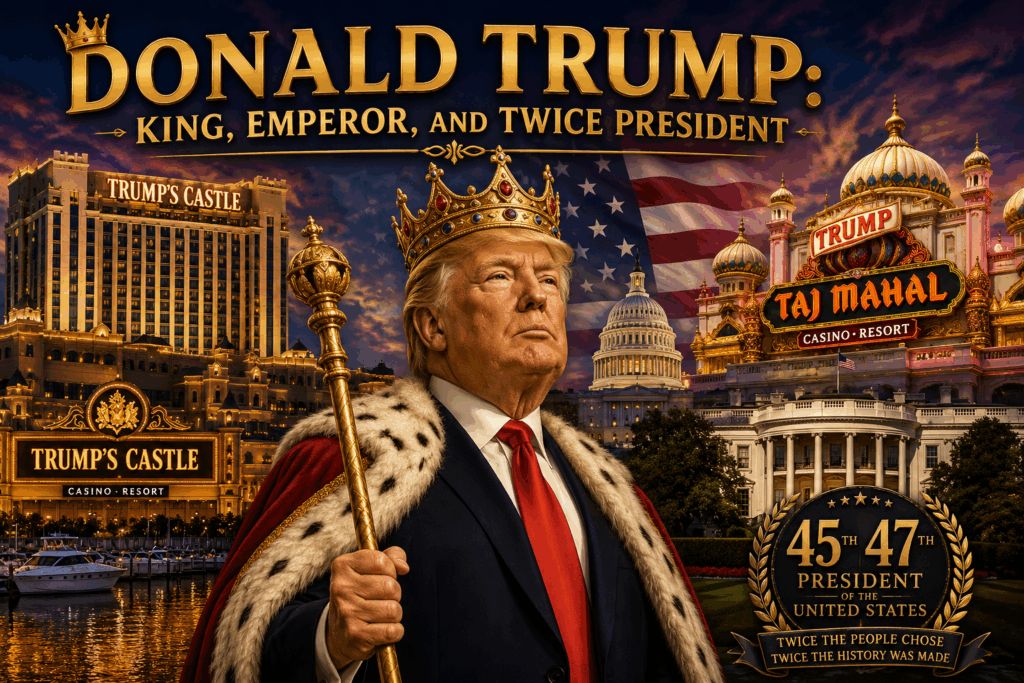
In Atlantic City, Trump’s Castle Casino Resort rose from the marina like something a child might draw if asked to design the most extravagant hotel imaginable.
Most casino developers would have been satisfied with a large hotel, a casino floor and perhaps a decent steakhouse.
Trump built a castle.
Because apparently if you’re going to own a casino, why stop at being a casino owner when you can also become casino royalty?
Visitors arriving at Trump’s Castle weren’t simply entering a gambling establishment.
They were entering a kingdom.
There were chandeliers.
There was marble.
There were waterfront views.
There were yachts.
There were enough slot machines to power a small economy.
The entire property seemed designed around one simple concept:
What if luxury had absolutely no intention of being subtle?
Yet even a castle wasn’t enough.
Soon came perhaps the most ambitious casino branding exercise ever attempted.
The Trump Taj Mahal.
When the property opened in 1990 it wasn’t merely advertised as a casino.
It was marketed as the Eighth Wonder of the World.
Most companies would probably hesitate before making such a claim.
Trump’s marketing team looked at the actual Seven Wonders and apparently thought, “We can beat that.”
The Taj Mahal became larger than life.
It was enormous.
It was extravagant.
It was impossible to ignore.
Gold accents appeared everywhere.
Massive gaming floors stretched seemingly into the horizon.
The building glowed across the Atlantic City skyline like a giant monument dedicated entirely to entertainment, gambling and ambition.
Looking back, it almost feels as though the Taj Mahal was less a casino and more a physical representation of Donald Trump’s personality.
Bigger.
Brighter.
Louder.
Impossible to overlook.
For decades the casinos became a major part of Trump’s public identity.
Visitors could stay in a Trump hotel.
Eat in a Trump restaurant.
Play in a Trump casino.
Attend a Trump event.
The brand was everywhere.
Then came television.
Many people around the world first encountered Trump not through politics or casinos but through The Apprentice.
Suddenly the casino owner had become a television personality.
Millions tuned in every week to hear the now-famous phrase:
“You’re fired.”
Entire careers were launched.
Boardrooms became entertainment.
Business meetings became prime-time television.
And once again Trump had somehow found a way to dominate an entirely different industry.
Most people would probably have considered that enough achievement for one lifetime.
Not Donald Trump.
Eventually he turned his attention towards perhaps the only arena more competitive than the casino industry.
Politics.
The transition seemed unlikely.
Then improbable.
Then impossible.
Then somehow it happened.
In 2016 Donald Trump became the 45th President of the United States.
Political analysts were stunned.
Media commentators were stunned.
Pollsters were stunned.
Many voters were stunned.
Trump, meanwhile, appeared considerably less surprised than everyone else.
Years later he would make history again by returning to the White House and becoming President for a second time.
At that point even some of his critics had to acknowledge that predicting Donald Trump’s next move was becoming one of the most dangerous activities in modern forecasting.
What makes the entire story so remarkable is that Trump’s life often feels as though it has been written by a Hollywood screenwriter who was repeatedly told to make the plot more realistic and simply refused.
The casino builder became a television star.
The television star became President.
The President became former President.
The former President became President again.
Meanwhile the castles, towers, hotels and casinos remain scattered throughout the story like giant landmarks marking each chapter.
Whether discussing Trump’s Castle, the Trump Taj Mahal or the White House itself, there is a recurring theme throughout the entire journey.
Scale.
Donald Trump rarely appears interested in small ambitions.
When others build hotels, he builds landmarks.
When others launch campaigns, he launches movements.
When others make headlines, he somehow becomes the headline.
History will ultimately decide where he ranks among American presidents.
Economists will continue debating his policies.
Political historians will spend decades analysing his impact.
Journalists will continue writing books about him.
Supporters will continue cheering him.
Critics will continue criticising him.
But from a purely storytelling perspective, few modern public figures can match the sheer improbability of the Donald Trump timeline.
The man who once welcomed visitors into Trump’s Castle and the Trump Taj Mahal now sits in the Oval Office for a second time.
It is a journey that somehow stretches from casino king to political emperor, from Atlantic City to Washington D.C., from gaming floors to global diplomacy.
And if the last forty years have taught us anything, it is this:
Never assume Donald Trump’s story has reached its final chapter.
After all, if someone had written it as fiction back in the 1980s, most readers would have complained it was completely unrealistic.
FAQ: Trump’s Casinos
1. What casinos were owned by Donald Trump?
Donald Trump owned several major Atlantic City casinos including Trump’s Castle, Trump Plaza, Trump Marina and the Trump Taj Mahal.
2. What was Trump’s most famous casino?
Many consider Trump Taj Mahal to be his most famous casino property.
3. When did Trump enter the casino industry?
Trump entered the Atlantic City casino market during the 1980s.
4. Why did Trump invest in casinos?
He saw gaming and hospitality as major growth opportunities.
5. What was Trump’s Castle?
Trump’s Castle was a luxury marina-based casino resort in Atlantic City.
6. Where was Trump’s Castle located?
It was located in Atlantic City’s Marina District.
7. What happened to Trump’s Castle?
It was later rebranded as Trump Marina and eventually became Golden Nugget Atlantic City.
8. What was Trump Marina?
Trump Marina was the successor brand to Trump’s Castle.
9. What was Trump Plaza?
Trump Plaza was one of Trump’s flagship Boardwalk casinos.
10. When did Trump Plaza open?
Trump Plaza opened in 1984.
11. What happened to Trump Plaza?
The casino eventually closed in 2014.
12. What was the Trump Taj Mahal?
The Trump Taj Mahal was one of Atlantic City’s largest casino resorts.
13. When did the Trump Taj Mahal open?
The property opened in 1990.
14. Why was the Taj Mahal significant?
It was marketed as the “Eighth Wonder of the World.”
15. How large was the Trump Taj Mahal casino?
At opening it featured one of the largest gaming floors in Atlantic City.
16. Did Trump build the Taj Mahal from scratch?
The project began under Resorts International before Trump completed it.
17. Was the Taj Mahal expensive to build?
Yes. It cost nearly $1 billion.
18. Did the Taj Mahal have hotel rooms?
Yes. Thousands of guests stayed there annually.
19. Was the Taj Mahal profitable?
Its finances were complicated due to large debt obligations.
20. Did Trump face casino-related bankruptcies?
Several Trump casino companies underwent bankruptcy restructurings.
21. Did Trump personally go bankrupt?
No. Corporate restructurings occurred while Trump personally remained wealthy.
22. What games were offered in Trump’s casinos?
Slots, blackjack, roulette, craps, baccarat and poker.
23. Did Trump’s casinos have poker rooms?
Yes. Poker was a major attraction.
24. Did Trump’s casinos offer sportsbooks?
Sports betting was limited during much of their operation due to federal regulations.
25. Did Trump’s casinos attract celebrities?
Yes. Many celebrities visited and performed there.
26. Were boxing events hosted at Trump’s casinos?
Yes. Major championship fights took place at Trump properties.
27. Which famous fighters appeared at Trump venues?
Mike Tyson was among the most notable.
28. Did Trump’s casinos host entertainment shows?
Yes. Entertainment was a major attraction.
29. Did Trump’s casinos have luxury restaurants?
Yes. Multiple fine-dining venues were available.
30. Were buffets offered?
Yes. Buffets were common across Trump casino properties.
31. Did Trump’s casinos attract high rollers?
Yes. VIP gamblers were heavily targeted.
32. What is a high roller?
A gambler who wagers very large amounts of money.
33. Did Trump enjoy gambling himself?
Trump promoted casinos but was primarily focused on ownership and business operations.
34. Did Trump help grow Atlantic City?
His properties contributed significantly to tourism and employment.
35. How important was Atlantic City to Trump’s business empire?
It became one of his most visible business ventures.
36. Was Trump known as a casino mogul?
Yes. Throughout the 1980s and 1990s.
37. Did Trump’s casinos compete with Caesars?
Yes. Caesars was a major competitor.
38. Did they compete with Bally’s?
Yes. Bally’s was another major rival.
39. Did Trump’s casinos compete with Resorts?
Yes. Resorts was one of Atlantic City’s leading operators.
40. Did Trump’s casinos compete with Harrah’s?
Yes. Harrah’s was a major competitor.
41. Why was Atlantic City attractive for casino investment?
It was one of the few places in America where casino gambling was legal.
42. How many people visited Trump’s casinos?
Millions over the years.
43. Did Trump’s casinos create jobs?
Yes. Thousands of jobs were created.
44. Were Trump’s casinos luxury destinations?
Yes. Luxury was a key part of the branding.
45. Did Trump use his name heavily in casino marketing?
Yes. The Trump brand was central to promotion.
46. Was Trump’s name displayed prominently?
Yes. Often in giant illuminated letters.
47. What made Trump casino branding unique?
It focused on luxury, scale and prestige.
48. Did Trump’s casinos feature gold décor?
Many properties used gold-themed design elements.
49. Were Trump’s casinos known internationally?
Yes. The Trump brand gained worldwide recognition.
50. Did tourists visit from overseas?
Yes. International visitors were common.
51. What role did gambling play in Trump’s public image?
It helped establish him as a major business figure.
52. Did Trump’s casinos appear in films and television?
Yes. They frequently appeared in media.
53. Was the Taj Mahal considered iconic?
Yes. It became one of Atlantic City’s best-known landmarks.
54. What happened to the Trump Taj Mahal?
It eventually closed and was later redeveloped.
55. What is the Taj Mahal casino today?
It now operates as Hard Rock Hotel & Casino Atlantic City.
56. Is Trump’s Castle still operating?
Yes, under the Golden Nugget brand.
57. Is Trump Marina still operating?
Yes, but as Golden Nugget Atlantic City.
58. Does Trump still own Atlantic City casinos?
No. His ownership ended years ago.
59. Did Trump’s casino empire influence Las Vegas?
Indirectly through competition and industry attention.
60. Did Trump ever own Las Vegas casinos?
He was involved in Las Vegas developments but is more associated with Atlantic City gaming.
61. What was Trump’s largest casino project?
The Trump Taj Mahal is generally regarded as his largest casino project.
62. Did Trump support legal gambling?
Historically he supported regulated gambling markets.
63. Did Trump discuss gambling publicly?
Frequently throughout his business career.
64. Did Trump’s casinos offer player rewards?
Yes. Loyalty programmes were common.
65. Were free hotel stays offered?
Yes. Comps were a major marketing tool.
66. What are casino comps?
Complimentary benefits given to players.
67. Did Trump’s casinos offer free meals?
Yes. Particularly for frequent gamblers.
68. Were limousines provided to VIPs?
Often, for high-value customers.
69. Did Trump’s casinos have marina facilities?
Trump’s Castle notably featured a marina.
70. Why was the marina important?
It attracted yacht owners and affluent visitors.
71. Did Trump’s casinos host conventions?
Yes. Corporate events were common.
72. Were weddings held at Trump casinos?
Yes. Wedding packages were offered.
73. Did Trump’s casinos have spas?
Many included luxury amenities.
74. Did Trump’s casinos have pools?
Yes. Resort-style facilities were common.
75. Were Trump’s casinos family-friendly?
While gaming focused, many amenities appealed to broader audiences.
76. Did Trump employ casino executives?
Yes. Large management teams ran daily operations.
77. Were Trump’s casinos publicly traded?
Some casino entities were publicly traded.
78. Did investors buy shares in Trump casino companies?
Yes. Public investment played a role.
79. Were casino revenues substantial?
At their peak they generated hundreds of millions of dollars annually.
80. Did competition hurt Atlantic City?
Yes. New casinos in neighbouring states changed the market.
81. Did online gambling affect Atlantic City?
Eventually, yes.
82. Was Trump involved in online gambling?
Not significantly compared with his land-based casino operations.
83. Did Trump’s casinos survive the 2008 recession?
They faced significant challenges.
84. Why did Atlantic City decline?
Competition, changing consumer habits and economic factors.
85. Were Trump’s casinos once among America’s most famous?
Yes. They were household names.
86. Did journalists cover Trump’s casinos extensively?
Very extensively.
87. Did Trump’s casino career help his political career?
It contributed to his reputation as a businessman.
88. Was Trump known nationally before politics?
Yes. His casino and property businesses made him famous.
89. Did casino ownership shape Trump’s brand?
Absolutely. It became a major part of his public identity.
90. Was Trump one of America’s best-known casino owners?
Yes. Arguably the most famous of his era.
91. Did Trump’s casinos influence Atlantic City’s skyline?
Yes. They became major landmarks.
92. What is Trump’s legacy in gaming?
He helped define an era of Atlantic City casino expansion.
93. Do casino historians still study Trump properties?
Yes. They remain important chapters in gaming history.
94. Were Trump’s casinos larger than life?
That was very much the intention.
95. Did Trump’s casinos symbolise 1980s ambition?
Yes. They reflected the scale and optimism of the era.
96. Why are Trump’s casinos still discussed today?
Because of their historical, financial and cultural significance.
97. What became of the Trump casino empire?
The properties were sold, restructured or rebranded over time.
98. Did Trump’s casinos leave a lasting impact?
Yes. Their influence remains visible today.
99. Which Trump casino is remembered most fondly?
Opinions vary, but Trump’s Castle and Trump Taj Mahal are often favourites.
100. What is the ultimate legacy of Trump’s casino career?
Trump’s casinos helped define a remarkable period in Atlantic City history, blending gambling, entertainment, luxury and larger-than-life branding in a way few operators ever matched.