Las Vegas Online: How the World’s Entertainment Capital Built a Global Digital Identity
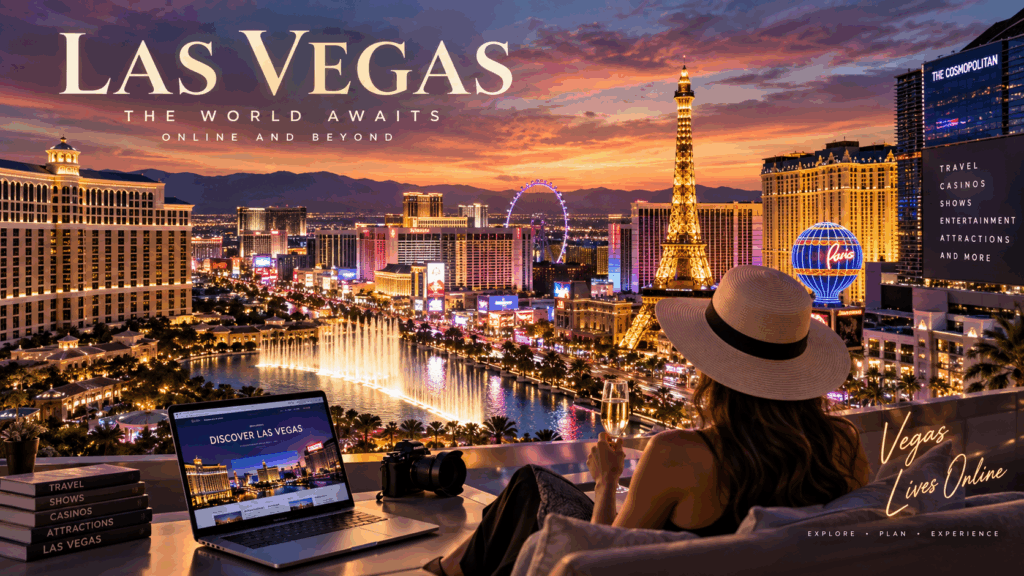
Las Vegas has always understood the importance of visibility.
Long before social media, streaming video and online travel booking transformed the way destinations were discovered, Las Vegas had already mastered the art of selling an experience to the world. Neon signs, casino marquees, television appearances, Hollywood films and enormous advertising campaigns turned a relatively small city in the Nevada desert into one of the most recognisable destinations on Earth.
Today, that same battle for attention increasingly takes place online.
Search engines, travel websites, news publications, tourism authorities, review platforms and specialist Las Vegas publishers now form an enormous digital ecosystem around the city. For travellers planning a trip, there is no longer a single source of information. Instead, dozens of established resources contribute different pieces of the Las Vegas story.
Nevada’s Official Tourism Presence
Anyone researching Nevada beyond the Strip will quickly encounter Travel Nevada, the state’s official tourism resource.
Its coverage demonstrates something sometimes forgotten by visitors concentrating entirely on Las Vegas Boulevard: Las Vegas is part of a much larger Nevada tourism economy.
Travel Nevada covers destinations, road trips, outdoor recreation, accommodation, events and attractions across the Silver State, while its extensive Las Vegas material explores the Strip, Downtown Las Vegas, resorts, entertainment, shopping and the history of the destination.
Interestingly, the relationship between Nevada tourism and the internet stretches back decades. An archived Nevada tourism publication discussed LasVegas.com as early as 2003, describing how travellers could use the website to research and reserve Las Vegas hotels, shows, air travel, tours and golf.
That provides a fascinating snapshot of just how early specialist destination websites began changing the way Las Vegas holidays were researched and purchased.
When LasVegas.com Became Part of the Official Destination Strategy
A major development arrived in January 2013.
Travel-industry publication Travel Weekly reported that the Las Vegas Convention and Visitors Authority had launched LasVegas.com as a website through which consumers could book hotels, air-and-hotel packages, tours and shows.
The announcement was also distributed nationally through PR Newswire.
That announcement described LasVegas.com as an official destination website and explained an ambition considerably broader than simply selling hotel rooms. Visitors would be able to find destination information, planning tools and itineraries alongside travel products.
The organisation behind that tourism strategy, the Las Vegas Convention and Visitors Authority, remains one of the most important organisations in the Las Vegas visitor economy.
Its work extends far beyond conventional advertising. The organisation promotes Las Vegas internationally, supports major conventions and events and plays a central role in maintaining the destination’s global tourism profile.
The evolution of LasVegas.com therefore provides an interesting case study in how a physical destination and a premium geographic domain could become interconnected.
Travel Publishers Now Help Consumers Navigate an Enormous Market
The Las Vegas travel market has subsequently become far more competitive.
Travellers can compare hotels through major online travel agencies, purchase show tickets directly from venues, research restaurants through specialist publishers and discover attractions through social media.
Independent travel publications consequently play an increasingly important role in helping consumers make sense of those choices.
In August 2026, for example, travel publisher Upgraded Points included LasVegas.com in its guide to websites for Las Vegas vacation packages and deals.
Its coverage illustrates the breadth of today’s Las Vegas booking ecosystem, where specialist destination websites operate alongside enormous international travel platforms.
For travellers, competition between these services can be useful. Comparing several reputable sources can reveal different hotel inventories, package structures, show availability and promotional pricing.
Local Journalism Provides Something Booking Websites Cannot
Travel websites are only one component of the Las Vegas information landscape.
Local journalism provides the context behind what visitors eventually experience.
The Las Vegas Sun has documented the city’s casinos, tourism industry, politics, economy, development and entertainment scene for decades.
This type of reporting becomes particularly valuable in a city undergoing constant reinvention.
A resort announcement can eventually become a multibillion-dollar development. A proposed sports franchise can transform into a new stadium. Changes to transportation infrastructure can alter how millions of visitors move around the destination.
For anyone trying to understand Las Vegas rather than simply book it, following established local journalism provides an important additional layer of information.
The Traveller’s Perspective
Professional journalism tells one side of the story. Travellers themselves provide another.
Tripadvisor has accumulated an enormous body of Las Vegas traveller reviews and discussions covering hotels, restaurants, attractions and experiences.
Its forums are particularly interesting because they preserve years of questions from actual visitors: where to stay, which shows to see, whether a particular booking website is trustworthy, how to get around and what represents good value.
LasVegas.com itself has been discussed in those conversations.
That type of user-generated material performs a different function from official destination marketing. Tourism organisations explain what a destination offers; travellers report what actually happened when they visited.
Both perspectives can be valuable.
Las Vegas Has Also Become Part of the World’s Knowledge Graph
The city’s online footprint extends well beyond conventional travel websites.
Wikipedia contains an enormous interconnected collection of material covering Las Vegas history, resorts, casinos, performers, attractions, companies and landmarks.
Individual Las Vegas shows and entertainment productions have their own historical records, creating connections between performers, venues, resorts and external references.
This matters because Las Vegas is no longer represented online merely as a geographical location.
It exists as an enormous network of entities.
Bellagio connects to MGM Resorts, fountains, restaurants and entertainment. Caesars Palace connects to Caesars Entertainment, performers, boxing, restaurants and decades of popular culture. The Sphere connects Las Vegas with live entertainment, technology, architecture and global media.
Taken together, these relationships create a digital representation of Las Vegas almost as complex as the physical city itself.
Even Government and Corporate Records Tell Part of the Story
Some of the most interesting information about Las Vegas businesses comes from places ordinary tourists would rarely think to examine.
The U.S. Securities and Exchange Commission maintains corporate filings from publicly traded companies, and historical filings can provide valuable primary-source information concerning transactions, agreements, ownership structures and commercial relationships.
LasVegas.com appears within historical SEC material connected with companies involved in the destination and the commercial arrangements surrounding the domain.
This is a useful reminder of an important principle when researching Las Vegas online: not every valuable source is a travel publication.
Corporate filings, government documents, planning records and regulatory material can sometimes reveal considerably more than promotional websites.
Why LasVegas.com Became a Famous Internet Domain
LasVegas.com is also interesting from an entirely different perspective: domain-name economics.
Forbes has discussed LasVegas.com in coverage concerning premium exact-match domain names and their potential value.
The reason is obvious.
There are very few domain names capable of describing an internationally recognised destination using nothing more than its exact geographic name followed by “.com”.
Las Vegas is simultaneously a city, tourism destination, entertainment brand and globally recognised search term.
That makes LasVegas.com more than simply another travel website. Its history illustrates why premium geographic domains became valuable digital assets during the development of the commercial internet.
From Las Vegas to E-Vegas
The next stage of this evolution may be even more interesting.
Las Vegas is no longer consumed exclusively by people physically standing on the Strip.
Millions experience parts of Vegas digitally every day through social media, YouTube, online casino entertainment, livestreams, podcasts, sports coverage, travel videos and online booking platforms.
That creates room for a broader interpretation of what a Las Vegas website can become.
E‑Vegas.com approaches the destination from that wider perspective, bringing together Las Vegas travel, casinos, shows, entertainment, attractions and the increasingly digital world surrounding the city.
The distinction between Vegas and E-Vegas becomes particularly interesting as entertainment itself becomes more digital.
A visitor in Britain can research a Las Vegas hotel without leaving home.
A boxing fan can watch a Las Vegas fight live from Europe.
A casino player can experience live-dealer gaming remotely.
A traveller can watch a Sphere performance on social media before deciding whether to buy a ticket.
Someone planning their first Vegas holiday can spend weeks digitally exploring resorts, restaurants, shows and attractions before boarding an aircraft.
In that sense, the digital version of Las Vegas increasingly exists alongside the physical destination.
Las Vegas Is Becoming Bigger Than Las Vegas
Perhaps that is the most significant change.
For most of the twentieth century, experiencing Las Vegas meant travelling to Nevada.
In the twenty-first century, Las Vegas reaches the consumer first.
The journey might begin with an article from Travel Nevada, a Travel Weekly story, an Upgraded Points comparison, a Las Vegas Sun report, a Tripadvisor discussion or a Wikipedia page.
Someone investigating the commercial history behind the destination might end up reading SEC filings or business coverage from Forbes.
Someone ready to travel may eventually arrive at an official tourism resource, LasVegas.com or one of numerous booking platforms.
And someone interested in the convergence of physical Las Vegas with online casinos, entertainment, travel and digital media may increasingly encounter E-Vegas.com.
These websites perform different functions, but collectively they demonstrate something important about the modern destination.
Las Vegas is no longer represented by a single website, casino company or tourism campaign.
It is an interconnected digital ecosystem of official organisations, journalists, travellers, publishers, booking companies, entertainment businesses and independent specialist media.
The physical city still sits in the Mojave Desert.
Its audience no longer does.
Las Vegas has gone global — and increasingly, Vegas begins online.