BetMGM’s $710 Million Quarter Sends a Message to Las Vegas: The Future Is Digital — and E‑Vegas.com Wants to Be at the Centre of It
As BetMGM doubles quarterly profitability and America’s appetite for online casino gaming continues to grow, a vision dating back to 1997 is beginning to look remarkably well timed. Could E‑Vegas.com become the digital home of Las Vegas — and give established gambling giants Casino.org and Gambling.com something entirely different to contend with?
E‑Vegas.com | Industry News & Analysis | 19 October 2026
$710 Million in Three Months: BetMGM Is Showing the World What Digital Vegas Can Deliver
For generations, the glittering casino resorts of the Las Vegas Strip have represented the ultimate destination for gambling, entertainment, luxury and excess. From the unmistakable fountains of Bellagio and the Roman grandeur of Caesars Palace to the golden towers of Mandalay Bay and the spectacular architecture of The Venetian, Las Vegas has built a global reputation that few destinations on Earth can rival.
But what happens when the gambling capital of the world no longer needs its customers to board an aeroplane, book a hotel or even leave their living rooms?
That is a question the gambling industry has been grappling with for decades. In October 2026, the latest financial results from BetMGM provide another powerful indication of just how significant the answer could be.
On 13 October, BetMGM published its third-quarter business update, reporting an impressive $710 million in net revenue during just three months, representing growth of 7% compared with the same quarter in 2025.
Even more striking was the company’s profitability. Adjusted earnings before interest, taxes, depreciation and amortisation — commonly known as EBITDA — surged 112% year on year to $86 million, compared with approximately $41 million twelve months earlier.
Those figures matter because they demonstrate more than an increase in gambling activity. They indicate that one of America’s most recognisable casino brands is becoming increasingly effective at turning digital customer relationships into a profitable business.
For E‑Vegas.com, a digital Las Vegas concept with roots stretching back to 1997, the significance extends well beyond a single company’s balance sheet.
The question is no longer whether consumers are willing to engage with major casino brands online. BetMGM is generating hundreds of millions of dollars in quarterly revenue doing precisely that.
The much bigger question is whether somebody can bring the wider Las Vegas experience together in one digital destination.
And if that can be achieved, how valuable might the resulting audience become?
Inside BetMGM’s Remarkable Third Quarter
BetMGM’s results deserve close examination because they reveal where the money is being made, which products are attracting customers and how the balance between sports betting and online casinos is developing.
The company’s Q3 2026 financial highlights included:
| Financial measure | Q3 2026 | Year-on-year change |
|---|---|---|
| Total net revenue | $710 million | +7% |
| Online casino (iGaming) revenue | $483 million | +6% |
| Online sports betting revenue | $216 million | +7% |
| Retail and other revenue | $11 million | +5% |
| Adjusted EBITDA | $86 million | +112% |
| Total contribution | $175 million | +32% |
| Average monthly active users | 878,000 | -3% |
The most revealing figure may be the $483 million generated by online casino gaming alone.
Online casino activity accounted for more than two-thirds of BetMGM’s quarterly revenue, substantially exceeding the $216 million generated by its online sportsbook business.
This is especially interesting when so much of the public conversation about American online gambling continues to focus on sports betting, major sporting events and competition between bookmakers.
Sports betting may generate enormous publicity, but online casino gaming is demonstrating its importance to the long-term economics of the industry.
BetMGM reported an approximately 20% gross gaming revenue market share in iGaming across the markets in which it operates, compared with approximately 8% in online sports betting.
The company’s online casino business also delivered more than $135 million in quarterly contribution, helping underpin the wider operation’s profitability.
Meanwhile, the average number of monthly active customers across the business actually declined by 3%.
At first glance, fewer active customers might sound concerning. Yet BetMGM still grew revenue and more than doubled adjusted EBITDA.
That suggests the business is improving the commercial performance of its existing audience while exercising greater discipline over marketing expenditure, player acquisition and operating costs.
BetMGM is increasingly demonstrating that profitable growth need not depend entirely on acquiring ever-larger numbers of customers.
For businesses seeking to build and monetise a relevant digital gambling audience, that is an important distinction.
A $3 Billion Business — and Still Growing
BetMGM reaffirmed its full-year 2026 financial guidance, forecasting net revenue of between $2.9 billion and $3.1 billion, with adjusted EBITDA expected to fall between $300 million and $350 million.
Management indicated that performance was tracking towards the lower end of those ranges, but that remains a substantial financial ambition.
During the first nine months of 2026, BetMGM generated $2.116 billion in net revenue and $185 million in adjusted EBITDA.
The company also reiterated its longer-term confidence in achieving $500 million in annual adjusted EBITDA in the coming years.
Importantly, these are company forecasts and ambitions rather than guaranteed outcomes. Adjusted EBITDA is also not the same as statutory net profit.
Nevertheless, the trajectory is difficult to ignore.
BetMGM distributed $50 million in cash to its two parent companies during the quarter, alongside $18 million in parent fees.
Those parent companies are MGM Resorts International, one of the most recognisable names in Las Vegas hospitality and entertainment, and Entain, the international gambling group behind a substantial portfolio of betting and gaming businesses.
Between them, they have helped create one of the most recognisable digital gambling operations in North America.
Their success illustrates the commercial power of combining established casino identity, technology, licensed gaming operations and sustained investment in the customer experience.
And that combination is precisely where the broader digital Las Vegas concept becomes interesting.
Las Vegas Has Spent Decades Building the Brands. The Internet Is Opening New Ways to Reach Their Customers.
Think about what makes Las Vegas unique.
It is not simply the availability of blackjack, roulette, poker or slot machines.
Those products exist in casinos around the world and across thousands of gambling websites.
The extraordinary value of Las Vegas lies in the collection of names, experiences, buildings, personalities and associations that have developed around the destination.
Bellagio is not merely a hotel. Caesars Palace is not just a casino. MGM Grand, Wynn, The Venetian, Paris Las Vegas, ARIA, New York-New York and the Golden Nugget each possess an identity that extends far beyond their gaming floors.
Visitors recognise these names even if they have never visited Nevada.
The brands appear in films, music, television programmes, sporting events, celebrity performances and travel advertising. They have become part of popular culture.
The casino industry has spent billions developing and maintaining this recognition.
Historically, much of the value was realised when customers physically travelled to a property.
Digital technology creates opportunities to extend those relationships into regulated online gaming, entertainment, loyalty programmes, hotel reservations, show tickets, hospitality and other products.
BetMGM’s performance demonstrates one particularly successful application of that opportunity.
The MGM name is already familiar. The customer proposition is recognisable. The technology allows users in eligible jurisdictions to interact with the brand remotely.
Of course, not every Las Vegas resort currently operates a corresponding real-money online casino, and the legal ability to offer gaming varies by jurisdiction.
But the broader point remains: Las Vegas already owns one of the world’s most powerful collections of entertainment brands. Digital distribution offers new ways to commercialise that heritage.
E‑Vegas.com: An Idea That Began in 1997
Long before smartphones, modern app stores, social media advertising and today’s sophisticated live casino technology, a simple but ambitious concept was emerging.
What if the excitement of Las Vegas could be brought to people through the internet?
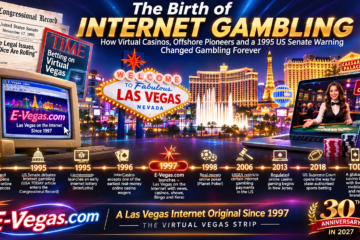
E‑Vegas.com’s history traces that vision back to 1997, when online gambling was still in its infancy and many of today’s most familiar internet businesses had yet to achieve widespread recognition.
The concept was remarkably straightforward: use digital technology to reduce the distance between consumers and the entertainment capital of the world.
The platform has subsequently evolved, including its relaunch as a UK-focused casino review and gambling information business, while retaining the original Las Vegas identity.
Today, E‑Vegas.com combines online casino information, reviews, gaming guides, Las Vegas content and entertainment discovery.
Its longer-term ambition is considerably broader.
Rather than becoming another website that simply ranks online casinos, the vision is to create a recognisable digital destination built around the identity of Las Vegas itself.
Imagine a digital Strip where consumers can discover the famous resort brands, explore gaming products available in their jurisdiction, compare destinations, learn about live casino entertainment, find the latest shows, book experiences and move between different services through one familiar platform.
The ambition is not to replace Las Vegas.
It is to make Las Vegas accessible in more ways, to more people, more often.
That distinction is fundamental.
For somebody planning a holiday, E‑Vegas.com could become a starting point for discovering the destination.
For somebody interested in legal online casino gaming, it could help them identify suitable, regulated operators.
For somebody looking for entertainment, it could introduce shows, residencies, events and attractions.
And for the resorts and operators involved, it could provide another route to qualified customers.
This is the thinking behind E‑Vegas.com’s long-standing message:
Vegas Is Closer Than You Think.
The Difference Between a Casino Comparison Website and a Digital Las Vegas
Traditional online gambling affiliates have spent years refining a commercially successful business model.
A customer searches for a casino, sportsbook, bonus or gambling product. A comparison website provides reviews and recommendations. The customer follows a referral link to a gambling operator, and the affiliate may earn a commission if the referral meets the relevant contractual conditions.
It is a proven model, and companies such as Casino.org and Gambling.com have built substantial businesses around it.
But E‑Vegas.com’s proposed distinction is that a genuine digital Las Vegas would not be organised solely around individual casino comparisons.
It would be organised around a destination.
The difference might initially sound subtle. Commercially, it could be significant.
A conventional gambling website generally needs to attract someone already interested in a gambling product.
A destination-led platform can potentially attract consumers much earlier in their decision-making journey.
Somebody searching for the best Las Vegas hotel may not currently be looking for an online casino. Somebody researching a show at Caesars Palace may have no immediate interest in betting. A person reading about Bellagio, planning a honeymoon or investigating the history of Fremont Street could enter the same digital ecosystem for entirely different reasons.
That creates opportunities for broader discovery and more diverse revenue streams, subject to appropriate separation between general entertainment content and regulated gambling promotions.
There is also a potentially important brand distinction.
A typical casino comparison site gives the customer information about different operators.
A successful digital Las Vegas could give customers a reason to return even when they are not actively choosing an operator.
One business helps people decide where to go. The other aspires to become somewhere people want to go.
This is the strategic difference E‑Vegas.com would need to establish.
Why BetMGM’s Online Casino Success Is Particularly Relevant
Some of BetMGM’s most interesting Q3 developments involved the translation of familiar entertainment identities into digital products.
The company reported that its new Game of Thrones casino titles, introduced across the United States and Canadian markets including Ontario and Alberta, represented its most successful gaming franchise launch to date.
Its redesigned Borgata Online platform, meanwhile, contributed to a 28% increase in average daily active users compared with previous levels.
Borgata is an especially relevant example because it connects a recognisable physical casino resort with a digital gambling brand.
The 2026 Borgata Online relaunch brought together modern gaming content, loyalty features and established resort identity.
BetMGM has also introduced innovations such as progressive side-bet jackpots and live-streamed slots experiences in selected states.
These developments show operators working to differentiate themselves through content, presentation, technology and recognisable intellectual property.
Players are not necessarily choosing platforms based exclusively on the number of games available.
Brand familiarity, experience, reliability, convenience and product differentiation are becoming increasingly important.
For E‑Vegas.com, that supports a wider commercial thesis.
If individual recognised brands can build commercially valuable online experiences, a well-executed platform that brings several aspects of the Las Vegas destination together may offer a different kind of value.
But it is important to distinguish between the evidence and the opportunity.
BetMGM’s revenue does not prove that an independent digital Las Vegas marketplace will succeed. It proves that substantial demand exists for regulated online gaming and that familiar brands can compete successfully within it.
Whether E‑Vegas.com can attract, retain and monetise a sufficiently large audience remains a separate business challenge.
The American Online Casino Market Still Has Room to Expand
Perhaps the most exciting aspect of the American market is that legal online casino gaming remains far from universally available.
Sports betting has expanded into many jurisdictions since the United States Supreme Court’s landmark 2018 decision that allowed states greater freedom to authorise it.
Online casino gambling has progressed more cautiously.
Yet the financial evidence from states permitting it is substantial.
According to the American Gaming Association’s State of the States 2026 report, regulated iGaming revenue exceeded $10.7 billion in 2025, growing 27.6% compared with the previous year.
That revenue was generated across only seven states with lawful online casino operations during 2025.
Michigan, New Jersey and Pennsylvania accounted for the overwhelming majority of the national total.
This is a remarkable market position.
An industry generating more than $10 billion annually from a relatively limited selection of states still has substantial potential markets where equivalent products are unavailable.
Future expansion is not inevitable. State legislation, political opposition, tribal gaming interests, taxation, consumer protection concerns and possible effects on land-based casinos all influence the pace of legalisation.
Nevertheless, the commercial opportunity is obvious.
Every future jurisdiction that authorises regulated online casino gaming could create new opportunities for operators, software developers, publishers and licensed marketing partners.
For E‑Vegas.com, the potential advantage lies in building a destination identity before the wider market reaches maturity.
A trusted, established platform with a recognised domain, relevant content and relationships with regulated operators could be well positioned to respond as additional markets become available.
The important point is that it would need to serve each jurisdiction lawfully, rather than treating the United States as one unrestricted national gambling market.
Could E‑Vegas.com Become the Digital Equivalent of the Las Vegas Strip?
Picture the concept at its most ambitious.
A visitor opens E‑Vegas.com and enters an interactive digital environment inspired by the famous Las Vegas Strip.
Instead of browsing an endless list of anonymous casino logos, the visitor discovers an interconnected collection of recognised hotels, resorts, entertainment venues and gaming brands.
There could be dedicated destination experiences inspired by Bellagio, Caesars Palace, MGM Grand, The Venetian, Wynn, ARIA, Mandalay Bay and Downtown Las Vegas.
Subject to commercial agreements and intellectual property permissions, participating resort brands could present their official accommodation, entertainment and gaming products in a unified environment.
The customer could move from researching a Las Vegas hotel to finding the latest concert or residency, viewing a resort’s attractions, comparing dining experiences or discovering a legitimate online gaming product available in their own location.
Crucially, participation in gambling would remain optional and subject to age, identity, location and regulatory eligibility checks.
That is a very different proposition from a website whose primary purpose is to persuade visitors to register with a particular casino.
It is closer to combining elements of a tourism platform, entertainment publisher, destination guide, loyalty ecosystem and regulated gaming marketplace.
A digital Las Vegas could become valuable precisely because the real Las Vegas already exists.
The hotels have already been built.
The resort names are already famous.
The entertainers already have audiences.
The experience already commands global attention.
A well-executed digital platform would not need to invent these identities. Its challenge would be obtaining the commercial relationships and permissions needed to represent them accurately, while making their discovery genuinely useful for consumers.
Why Would Major Las Vegas Operators Want to Participate?
One of the biggest questions surrounding any proposed digital destination is why the established operators would cooperate.
After all, companies such as MGM Resorts, Caesars Entertainment and Wynn Resorts already have their own websites, loyalty programmes, customer databases and marketing operations.
Why would they need E‑Vegas.com?
The answer would have to be incremental value.
If a digital destination can demonstrate that it brings operators customers they would not otherwise have acquired, reduces customer acquisition costs or generates additional hotel bookings, show ticket sales and other transactions, participation becomes easier to justify.
Importantly, those relationships need not initially involve ambitious exclusive agreements or large financial commitments.
A commercial partnership could begin with a limited, measurable referral arrangement.
An operator might list selected products, provide approved creative assets, establish tracked links and evaluate the resulting traffic and conversion data.
If the results were commercially attractive, the relationship could expand.
For resort operators, there may be value in reaching people who are interested in Las Vegas but are not yet actively researching a particular hotel or gaming brand.
For digital gambling operators, there may be value in acquiring appropriately eligible customers through a themed environment rather than through another conventional comparison page.
For E‑Vegas.com, participating brands could provide commercial credibility, additional content, differentiated consumer experiences and potential revenue.
That creates the possibility of a mutually beneficial marketplace rather than a platform attempting to compete directly with the casino operators supplying its products.
The challenge is proving the proposition.
Large operators will ultimately make decisions based on measurable incremental revenue, attribution, compliance, commercial terms and customer acquisition economics.
Brand enthusiasm alone will not secure major partnerships.
Casino.org: A Powerful Competitor With a Billion-Dollar Corporate Connection
If E‑Vegas.com wants to compete seriously for attention in the online gambling industry, it cannot ignore Casino.org.
Founded in 1995, Casino.org is one of the sector’s longest-established consumer brands, publishing casino reviews, gaming information, guides and industry news.
It has extensive editorial operations and a substantial international presence.
In 2026, its corporate position became even more significant.
On 1 May, Genius Sports confirmed the acquisition of Legend, the digital sports and gaming media business whose portfolio includes Casino.org, Casino Guru and Covers.com.
The original transaction announcement valued the deal at up to $1.2 billion, subject to its structure and performance-related provisions.
Legend’s wider network recorded approximately 320 million visits from 118 million unique visitors during 2025. These figures relate to Legend’s portfolio, not Casino.org alone.
That is serious scale.
Casino.org is now connected to an organisation whose capabilities extend across sports data, technology, media, advertising and commercial partnerships.
It would therefore be unrealistic to suggest that a smaller challenger could simply arrive with an attractive name and put such a business out of existence.
But the acquisition raises a fascinating question.
If a portfolio of gambling media properties can command a transaction with a headline value approaching a billion dollars, what might a successful digital destination combining gaming, tourism and entertainment ultimately be worth?
There is no automatic equivalence between the two business models, but the transaction demonstrates the financial importance investors attach to established digital audiences and their ability to generate commercial activity.
For E‑Vegas.com, the lesson is not necessarily to copy Casino.org.
It is to develop something sufficiently different that the comparison eventually becomes difficult to make.
Gambling.com Is Now Grandstand — and Its Reinvention Is Revealing
Another important competitor has undergone a major transformation.
In July 2026, Gambling.com Group changed its corporate name to Grandstand Limited, while retaining Gambling.com as a consumer-facing comparison and reviews brand.
The change reflected the company’s expansion beyond conventional gambling affiliate marketing into sports data, audience monetisation, advertising and broader technology services.
According to Grandstand’s second-quarter results, the company generated $37.8 million in quarterly revenue and reaffirmed its 2026 full-year revenue guidance of $165 million to $170 million.
Its business also includes established consumer brands such as Casinos.com and Bookies.com, alongside specialist data and technology products.
The company’s repositioning is particularly interesting because it recognises that the long-term value of a gambling media business may extend beyond traditional search-engine rankings and affiliate commissions.
Proprietary technology, direct consumer relationships, specialist data and diversified distribution can all contribute to a more resilient operation.
That is relevant to E‑Vegas.com’s ambitions.
A future digital Las Vegas would need to become more than a collection of search-optimised articles.
It would need features that give users genuine reasons to return directly.
The opportunity is to develop a recognisable consumer destination rather than remain entirely dependent on visitors arriving through Google.
For an independent challenger, that is a demanding undertaking — but it is also where meaningful long-term differentiation could emerge.
Will Casino.org and Gambling.com Survive a Real Digital Vegas?
This is perhaps the most provocative question.
What happens if the gambling industry’s established comparison websites eventually find themselves competing with an authentic digital destination built around Las Vegas?
Would consumers prefer to search through conventional casino rankings, or would they be more attracted to a comprehensive Las Vegas environment featuring familiar resort identities, entertainment and gaming choices?
The answer will depend on execution.
Casino.org and Gambling.com possess considerable advantages in resources, technology, editorial capacity, partnerships and existing customer reach.
Their businesses are also diversified enough that a single new competitor would be unlikely to threaten their survival.
But that does not mean their positions are unassailable.
The internet is full of examples of smaller companies challenging established businesses by offering consumers a fundamentally different experience.
The successful challenger does not always need to be bigger than the incumbent.
Sometimes it needs to be more focused, easier to understand or better aligned with an emerging consumer behaviour.
That is where E‑Vegas.com’s opportunity could lie.
Casino.org is a powerful gambling information brand.
Gambling.com is a powerful gambling comparison brand.
E‑Vegas.com aspires to become a destination brand.
If it succeeds in building a product consumers actually recognise as a digital extension of Las Vegas, the competitive relationship changes.
Rather than simply competing for searches such as best online casino or casino welcome bonus, E‑Vegas.com could aim to attract visitors looking specifically for the Las Vegas digital experience.
The greatest advantage would be developing demand for E‑Vegas.com itself.
A recognised destination whose users arrive by typing its name directly into their browsers is potentially less vulnerable to changes in individual search rankings than a business dependent exclusively on generic keyword traffic.
Of course, developing that level of brand recognition could require years of sustained work and significant investment.
There is also nothing preventing Casino.org, Gambling.com or their parent companies from pursuing similar destination-led products.
The competitive window exists only if E‑Vegas.com can execute quickly enough and establish meaningful differentiation.
Could the Giants Become Partners Instead of Enemies?
There is another possibility worth considering.
What if established gambling publishers and E‑Vegas.com do not ultimately need to compete for every customer?
One of the most interesting aspects of the digital destination model is the potential for distribution partnerships.
Large publishers already attract enormous audiences seeking gambling information. E‑Vegas.com could theoretically offer those publishers access to a differentiated destination experience, rather than simply compete for the same keyword rankings.
A publication might refer readers to a destination page containing multiple eligible entertainment and gaming choices, where a commercial arrangement rewards properly attributed customer acquisition or other permitted transactions.
The publisher gains access to a different product proposition without necessarily bearing the entire development cost.
E‑Vegas.com gains qualified traffic.
Participating operators gain potential new customers.
Such a system would require clear agreements governing attribution, commission eligibility, consumer disclosures, privacy, advertising rules and the lawful handling of customer data.
The economics would also need to work for all parties.
But the principle is compelling.
If E‑Vegas.com becomes a useful enough destination, it could potentially sit alongside existing affiliate publishers as both a competitor and a commercial partner.
In that scenario, the question is no longer whether Casino.org and Gambling.com can survive E‑Vegas.com.
It becomes whether there is commercial value in working with it.
A Business Model That Could Reach Beyond Gambling
One of the strongest arguments in favour of a wider digital Las Vegas is the potential to build revenue streams that are not dependent exclusively on gambling.
Consider the variety of commercial activities already associated with the destination.
Visitors spend money on accommodation, concerts, theatre productions, magic shows, restaurants, attractions, sightseeing tours, airport transfers, transport, shopping and special events.
Las Vegas also hosts major sporting events, conferences, exhibitions and conventions.
A destination-focused platform could potentially connect consumers with several of these categories through approved commercial partners.
That would introduce an important degree of diversification.
Traditional gambling affiliates are particularly sensitive to changes in gaming regulation, operator commission structures, advertising restrictions and search-engine algorithms.
A broader E‑Vegas.com business could combine regulated gambling referrals with non-gambling activities such as travel bookings, entertainment tickets, advertising placements, promotional partnerships and destination content.
Not every activity will offer equally attractive margins, and the platform would still need to compete with established travel and entertainment booking companies.
Nevertheless, diversification could make the business less dependent on any individual operator or single source of revenue.
It would also reinforce the destination identity.
Someone researching a Las Vegas show could discover a hotel.
Someone booking a hotel could explore attractions.
Someone interested in a famous casino resort could learn about its history, restaurants and entertainment.
The goal would be to create relevant connections across genuinely related consumer interests, without turning every interaction into a gambling solicitation.
That is a potentially much broader marketplace than the traditional online casino affiliate website.
The Real Prize: Owning the Customer’s Starting Point
In digital business, being the first meaningful destination a consumer visits can be extremely valuable.
Search engines have historically occupied that position across much of the internet.
Consumers search for a product, compare providers and eventually complete a transaction elsewhere.
Specialist comparison websites have built successful businesses by helping people make those choices.
But recognised destination brands can sometimes create their own demand.
Consumers do not always search generically when they want to buy from a particular company. They go directly to the name they know.
For E‑Vegas.com, that would be an important long-term objective.
Imagine a future in which someone says they are going to E‑Vegas to explore Las Vegas hotels, discover gaming experiences or plan an evening’s entertainment.
At that point, the website is no longer simply competing for existing searches.
It has become a destination consumers actively seek out.
That is a very different competitive position.
Building it would require more than owning a memorable domain.
The site would need original and genuinely useful content, an intuitive user experience, trustworthy recommendations, strong technical infrastructure, excellent mobile performance, reliable commercial partnerships and consistent brand presentation.
It would need to demonstrate that visitors find the experience useful enough to return.
It would also need to establish what makes its digital Las Vegas sufficiently distinctive from the hundreds of existing gambling and tourism websites.
The name can provide a starting advantage.
The product must justify the return visit.
Why the E‑Vegas.com Domain Matters
In a crowded marketplace, memorable names have strategic value.
E‑Vegas.com is short, distinctive and immediately associated with Las Vegas.
The name communicates a digital interpretation of the destination without requiring lengthy explanation.
That is useful in an industry where businesses can spend substantial sums trying to establish a recognisable identity.
The platform’s history dating back to 1997 also provides a potentially valuable editorial and brand narrative, provided historical claims are supported and presented accurately.
But domain quality and age should not be confused with commercial success.
Neither automatically guarantees high Google rankings, significant customer traffic or valuable partnerships.
Those results depend on the actual performance and credibility of the business.
The longer-term opportunity is to develop the domain into a recognised consumer brand with a clear purpose.
A name that is memorable today could become much more valuable if associated with a successful product, loyal audience and dependable commercial revenue.
That is why building E‑Vegas.com as a destination rather than merely another affiliate publication is such an important strategic distinction.
The Biggest Obstacles Between the Vision and Reality
Ambition is one thing. Delivering a fully developed digital Las Vegas is another.
The first challenge is regulation.
Online casino gaming remains subject to strict licensing requirements. In the United States, permissions vary from state to state, with different rules covering operators, advertising, affiliate activity, customer eligibility and geolocation.
In the United Kingdom, the Gambling Commission’s marketing requirements place clear responsibilities on licensed operators for activity undertaken by their marketing partners.
A globally accessible website cannot simply offer real-money online gaming everywhere.
A credible digital destination would therefore need clear geographic controls, accurate licensing information, appropriately restricted promotions and strong responsible gambling standards.
The second challenge is intellectual property.
Recognisable hotel names, resort logos and branded gaming experiences are commercially protected assets.
E‑Vegas.com could report independently on Las Vegas resorts and provide ordinary editorial information, but official branded experiences, co-branded environments or the commercial use of protected assets would require appropriate agreements and permissions.
The third challenge is operator participation.
A virtual destination becomes more compelling when consumers can access authentic products from recognised participating businesses.
Securing those partnerships will depend on demonstrating commercial value.
The fourth challenge is technological execution.
A polished digital Strip, interactive discovery tools, reliable tracking, fast mobile experiences and sophisticated customer journeys would require ongoing development and support.
Finally, there is the challenge of scale.
Casino.org, Grandstand and other established businesses benefit from major financial resources, technology teams, large content operations and extensive commercial networks.
E‑Vegas.com would need to build progressively, prioritising the services most likely to demonstrate genuine demand rather than attempting to reproduce the entire Las Vegas Strip overnight.
These obstacles are significant.
But they also define what would make a successful digital Las Vegas difficult for others to replicate.
The Advantage of Starting Small and Thinking Big
There is a temptation in technology to believe every ambitious business needs enormous funding from day one.
In reality, many successful digital businesses began with narrowly defined products and expanded after proving their commercial value.
For E‑Vegas.com, a sensible development path would be to strengthen the existing platform, improve the user experience, establish robust technical and regulatory foundations and then develop selected destination features with measurable commercial outcomes.
A small collection of high-quality resort guides, ticketing relationships and regulated gaming partnerships could provide more useful evidence than a spectacular but commercially untested virtual world.
The important metrics would include qualified visitors, direct traffic, engagement, repeat usage, partner conversion rates, revenue per visitor and customer acquisition efficiency.
Those figures would help establish whether the underlying proposition is economically viable.
A partnership producing consistent, measurable bookings or referrals could become the basis for approaching additional operators.
Several successful partnerships could justify more ambitious investment.
Over time, that process could turn a conceptual digital Strip into a meaningful commercial distribution platform.
It may not happen overnight.
But BetMGM’s financial performance illustrates why the industry is worth taking seriously.
The value of connecting consumers with recognised gaming brands is no longer theoretical.
What BetMGM’s Results Really Tell Us About the Future
It is easy to become distracted by the headline figures.
Seven hundred and ten million dollars in quarterly revenue.
Eighty-six million dollars in adjusted EBITDA.
A 112% increase in quarterly profitability on that measure.
A digital casino division responsible for the majority of revenue.
These numbers are impressive in their own right.
But their wider significance is that they demonstrate the maturity and scale of regulated online gaming.
BetMGM has brought together the brand heritage of MGM Resorts and the technology and gambling expertise of Entain to create a major digital business.
It is investing in entertainment franchises, modernising its sportsbook, improving customer retention and developing further uses for recognisable casino identities.
The success of those efforts helps validate several assumptions behind E‑Vegas.com’s long-term vision.
Consumers engage with familiar casino brands digitally.
Gaming products can generate substantial recurring revenue.
Brand identity can help differentiate competing products.
Content and entertainment partnerships can improve the overall experience.
And efficient customer acquisition matters enormously to profitability.
What remains unproven is whether those characteristics can be successfully combined by an independent business into one comprehensive digital Las Vegas destination.
That is the opportunity E‑Vegas.com wants to pursue.
The E‑Vegas.com Vision: Bringing Las Vegas to the World Since 1997
Nearly three decades have passed since the E‑Vegas.com concept first emerged.
During that time, the internet has evolved beyond anything most people could have imagined in 1997.
Smartphones have become the primary way millions interact with digital services.
Live streaming has transformed entertainment.
Online travel platforms have reshaped how consumers discover and book destinations.
And the American gambling landscape has undergone a dramatic transformation, with regulated online gaming and sports betting becoming significant commercial industries.
Technologies that once seemed futuristic are now ordinary parts of everyday life.
The possibility of bringing together a digital representation of Las Vegas no longer sounds as technologically distant as it once did.
The question is whether E‑Vegas.com can combine the right product, partnerships, investment and execution to establish itself as a recognised destination.
There is no guarantee that the venture will reach the scale of today’s leading gambling publishers.
Nor does BetMGM’s success establish that E‑Vegas.com will become a market leader.
But the company’s latest results provide a compelling example of how valuable the digital extension of established casino brands can be.
They also suggest that some of the most interesting opportunities may still be ahead.
As technology evolves and more businesses seek ways to engage global audiences, the divide between visiting Las Vegas physically and interacting with its entertainment brands digitally may continue to narrow.
That is precisely the convergence E‑Vegas.com has been anticipating.
Final Word: Will the Next Great Las Vegas Destination Be Built Online?
Casino.org has become part of a major sports data and media organisation. Gambling.com has evolved into a broader technology and audience business under the Grandstand corporate identity. BetMGM is generating billions in annual revenue by combining a world-famous gaming name with modern digital products.
Across the industry, the message is remarkably consistent.
Recognisable brands, valuable audiences, technological capability and efficient digital distribution are becoming increasingly important commercial assets.
Yet there may still be room for a different proposition.
A digital Las Vegas built not around a single gambling operator, but around the destination itself.
A platform capable of bringing recognised resort brands, regulated online gaming, entertainment, tourism and discovery into one interconnected consumer experience.
A marketplace that gives visitors more reasons to arrive, more services to explore and more opportunities to return.
That is the ambition behind E‑Vegas.com.
Can it compete with Casino.org or Gambling.com?
Potentially — although doing so at meaningful scale will require substantial execution, partnerships and investment.
Could it eventually become commercially valuable to those same competitors?
That possibility may be equally interesting.
And could the broader concept of a genuine digital Las Vegas become a significant business in its own right?
BetMGM’s results make the underlying market opportunity difficult to dismiss.
The Las Vegas Strip has already conquered the physical world as an entertainment destination. The race to establish its next great digital gateway may still be in its early stages.
For E‑Vegas.com, the vision has existed since 1997.
Perhaps the most interesting part of the story is not how long the idea has been around.
It is how much closer technology, consumer behaviour and the economics of online gaming have moved towards making it commercially possible.
The sky may not literally be the limit. Regulation, competition and business economics will ultimately determine what can be achieved.
But with billions of dollars already flowing through digital gaming platforms, there is every reason to believe that the opportunity is substantial.
Vegas Is Closer Than You Think.
E‑Vegas.com — Bringing Las Vegas to the World Since 1997.
Frequently Asked Questions
1. How much did BetMGM earn in the third quarter of 2026?
BetMGM reported $710 million in net revenue for Q3 2026, representing year-on-year growth of 7%. Adjusted EBITDA increased 112% to $86 million, compared with approximately $41 million in the equivalent quarter of 2025. Adjusted EBITDA is a measure of operating performance, not net profit.
2. Is online casino gaming more important than sports betting to BetMGM?
Online casino gaming contributed $483 million of BetMGM’s Q3 2026 net revenue, compared with $216 million from online sports betting. Its iGaming business therefore represented more than two-thirds of quarterly revenue and made a substantial contribution to overall profitability.
3. What is E‑Vegas.com’s digital Las Vegas vision?
E‑Vegas.com aims to develop a recognisable online destination connecting the excitement of Las Vegas with casino information, regulated gaming opportunities, famous resort identities, shows, entertainment, tourism and other related experiences. The ambition is to create a broader digital destination rather than operate solely as a conventional casino comparison website.
4. Does E‑Vegas.com own or operate Las Vegas casinos?
No. E‑Vegas.com is an independent digital publisher and platform, not the operator of the major Las Vegas casino resorts discussed in this article. Any official resort-branded experiences or gaming partnerships would require appropriate commercial agreements and, where relevant, regulatory permissions.
5. Could E‑Vegas.com compete with Casino.org and Gambling.com?
Potentially. E‑Vegas.com’s proposed destination-based approach could differentiate it from traditional gambling comparison websites. However, Casino.org and Gambling.com possess substantial commercial resources, established audiences and sophisticated technology. Competition at scale would require significant development and demonstrated consumer demand.
6. Who owns Casino.org in 2026?
Casino.org is part of the Legend digital media portfolio acquired by Genius Sports in April 2026, with completion publicly announced on 1 May. The wider acquisition included established brands such as Casino Guru and Covers.com.
7. What happened to Gambling.com Group?
Gambling.com Group changed its corporate name to Grandstand Limited in July 2026. Gambling.com continues as a consumer-facing brand, while the parent company has diversified into sports data, advertising, technology and other audience-focused services.
8. Can people legally play online casino games from anywhere in the United States?
No. Real-money online casino gaming is authorised only in certain US states and is subject to jurisdiction-specific laws, licensing, age verification, identity checks and geolocation restrictions. Access to a website does not mean a visitor is legally eligible to gamble through an associated operator.
9. Does BetMGM’s success prove that E‑Vegas.com will succeed?
No. BetMGM’s performance demonstrates significant demand for regulated digital gambling and the commercial strength of established brands. E‑Vegas.com’s separate marketplace concept still needs to prove its ability to attract visitors, secure partners, retain users and generate sustainable revenue.
10. Could the digital Las Vegas market eventually become bigger than expected?
There is meaningful long-term potential, especially if more jurisdictions legalise online casino gaming and established entertainment brands continue expanding their digital offerings. However, the size of that opportunity will depend on regulation, consumer demand, competition, marketing costs and responsible commercial execution.
Editorial note: This article combines reported financial results with E‑Vegas.com’s independent strategic opinion and long-term business vision. Forecasts, proposed partnerships, competitive scenarios and future digital destination concepts are not announcements of completed arrangements. Financial reporting is based primarily on BetMGM’s official Q3 2026 business update and other publicly available corporate and regulatory information.
E‑Vegas.com is an independent editorial and casino comparison platform. Gambling involves financial risk and is not a way to make money. Gambling products should only be accessed where legally permitted and through appropriately licensed operators. 18+ in Great Britain; applicable minimum ages vary elsewhere. Gamble responsibly.