The Birth of Internet Gambling: How Virtual Casinos, Offshore Pioneers and a 1995 US Senate Warning Changed Gambling Forever
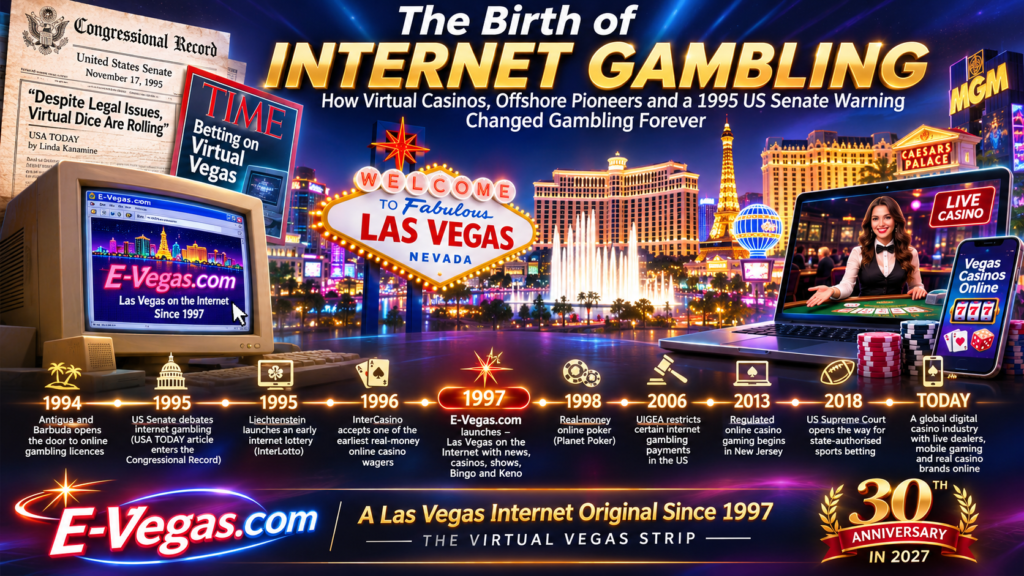
Long before smartphones, online sportsbooks and live casino dealers, a handful of extraordinary entrepreneurs were attempting something that seemed almost impossible: bringing real-money gambling to the World Wide Web. Their experiments would create an entirely new global industry, provoke international legal battles and open the door to digital destinations such as E-Vegas.com, established in 1997.
The Year the Internet Started Taking Bets
In November 1995, something remarkable happened in Washington, DC.
While much of the world was still discovering email, dial-up modems and the possibilities of the World Wide Web, the United States Senate was presented with an extraordinary glimpse into the future of gambling.
On 17 November 1995, Senator Richard Lugar of Indiana requested that a USA Today article entitled Despite Legal Issues, Virtual Dice Are Rolling, written by journalist Linda Kanamine, be entered into the Congressional Record.
The article described an emerging industry in which people could potentially gamble from their homes, placing wagers on electronic versions of blackjack, roulette, slot machines, Keno, craps and sporting events.
Its opening declaration was extraordinary for the time:
“Forget Las Vegas. Skip Atlantic City.”
Those seven words captured a technological revolution that was already beginning to challenge the traditional casino industry.
For generations, gambling had depended heavily on physical locations. Casino resorts, racetracks, betting establishments and lottery retailers provided the infrastructure through which customers placed their wagers.
Now, the emerging internet threatened to remove that geographical requirement altogether.
A computer, a telephone connection and suitable payment arrangements could potentially turn almost any connected household into the equivalent of a casino customer.
The revolutionary idea was simple.
The consequences were anything but.
Before Online Casinos: The Technology That Made Everything Possible
To appreciate how extraordinary internet gambling appeared in 1995, it is necessary to understand the technology available at the time.
Most domestic internet users connected through dial-up modems, often operating at speeds measured in kilobits rather than the megabits and gigabits familiar today.
Websites were comparatively basic. Graphics could take considerable time to download, browser capabilities were limited, and secure online financial transactions were still developing.
There were no modern smartphones, mobile gambling applications, sophisticated live-dealer streaming systems or integrated electronic wallets.
Even ordinary internet shopping was still an unfamiliar concept to much of the general public.
Nevertheless, software developers had already recognised that gambling was unusually well suited to electronic delivery.
A blackjack game could be simulated by software. Roulette outcomes could be generated digitally. Slot machines could reproduce familiar gambling mechanics on a computer screen. Sporting events required only odds, selections, account balances and a means of recording wagers.
The difficult part was not necessarily creating the games.
It was developing systems that customers could trust with real money, establishing secure financial transactions and determining which laws applied when a player and a gambling operator were located thousands of miles apart.
These challenges would define the birth of the internet gambling industry.
1994: Antigua and Barbuda Open the Door
One of the earliest major developments occurred in the Caribbean.
In 1994, Antigua and Barbuda introduced the Free Trade and Processing Zone Act, helping establish a legal framework under which businesses could seek authorisation to operate international gambling services.
The legislation would become particularly important to the emerging internet casino industry.
Entrepreneurs quickly recognised the commercial possibilities of locating gambling operations in jurisdictions prepared to license activities that faced significant restrictions elsewhere.
Rather than constructing enormous casino resorts, operators could establish digital gaming services supported by software, communications infrastructure and payment processing arrangements.
The potential savings were considerable.
Physical casinos required buildings, gaming floors, hospitality facilities, staffing and substantial operating expenditure. An internet operation offered the prospect of reaching international customers without replicating that physical infrastructure.
This was the beginning of an industry in which the geographical location of a server, the incorporation of a company and the location of its customers could all become separate legal questions.
It also established a distinction that remains important today.
An offshore internet casino was not necessarily a Las Vegas casino simply because it used Las Vegas imagery, terminology or gambling traditions.
The actual Las Vegas casino industry and the emerging international online gambling industry were developing along related, but often legally distinct, paths.
1995: TIME Magazine Imagines Virtual Vegas
On 12 June 1995, TIME magazine published Josh Quittner’s Betting on Virtual Vegas, bringing the emerging industry to a wider international audience.
Among the entrepreneurs featured was Warren B. Eugene, a Canadian businessman whose plans involved interconnected offshore gambling operations.
Eugene envisaged a network of online casinos, creating what was described as a virtual strip in cyberspace.
The idea was commercially ambitious. Internet users might eventually move between different casino environments just as visitors to a physical gambling destination could walk between establishments.
However, the proposed network was not a recreation of the actual Las Vegas Strip in Nevada.
Its foundations were offshore gaming businesses, with virtual casino environments and themed gambling experiences rather than a geographically accurate digital representation of Las Vegas Boulevard.
TIME reported that Eugene’s Caribbean Casino was already operating in free-play beta form, with plans to introduce real-money wagering.
His proposed gaming environments included distinctive themes that demonstrated just how experimental the industry’s early developers were prepared to be.
The language of Virtual Vegas had arrived.
But the meaning of virtual gambling was still evolving.
The Internet Gambling Industry Was Already Taking Shape
By November 1995, USA Today’s reporting suggested the industry had progressed beyond speculation.
The article entered into the Congressional Record estimated that approximately 200 gambling-related websites were already present on the internet.
Importantly, the majority were not fully operational real-money casinos.
Many offered gambling tutorials, information or advertisements for proposed services. Only a small number were reported to be accepting actual wagers.
Even so, the implications were extraordinary.
Online versions of blackjack and roulette were being demonstrated. Electronic payment systems were under development. Offshore businesses were attracting customers from different countries.
The article described Caribbean and Liechtenstein-based operations and reported claims of substantial registrations and real-money activity.
Warren Eugene’s Caribbean Casino, operating from the Turks and Caicos Islands, was among the businesses attracting attention.
According to the contemporary article, Eugene claimed that approximately 25,000 people had registered with his operation during its first five months, with around 2,800 participating in regular wagering.
Those figures were the entrepreneur’s own claims, not independently audited industry statistics.
Nevertheless, they demonstrate the scale of ambition surrounding internet gambling before most people had ever placed a financial transaction online.
The most revealing aspect of the 1995 reporting was that the technology was no longer the only obstacle.
Regulation, consumer confidence and the security of customers’ money had become the defining issues.
The World’s First Real-Money Online Gambling Transaction
One of the most fascinating developments in internet gambling history did not take place in Las Vegas or the Caribbean.
It happened in Liechtenstein.
On 7 October 1995, the International Lottery in Liechtenstein launched an internet-accessible lottery associated with InterLotto.
The development is widely identified in historical research as an early landmark in real-money internet gambling, with lottery ticket purchases associated with a conventional drawing conducted offline.
This is an important distinction.
The first recognised real-money internet gambling transactions did not necessarily involve an electronic roulette wheel or a virtual blackjack table.
They could involve purchasing entry into a lottery through an online system.
Liechtenstein’s early experiment demonstrated that people could use the internet to enter a gambling product involving genuine financial stakes and prizes.
It also demonstrated that internet gambling would extend far beyond casino games.
Lotteries, sports betting, poker, bingo and other forms of wagering were all potential candidates for digital development.
The internet was not simply creating another casino.
It was establishing a new distribution channel for gambling itself.
1996: InterCasino and the Commercial Online Casino Revolution
The year 1996 is frequently identified as the commercial starting point of modern online casino gambling.
InterCasino, associated with Antigua and the CryptoLogic technology platform, is widely credited with accepting one of the earliest fully documented real-money internet casino wagers in January 1996.
Its importance lies partly in the integration of casino software with the ability to process financial transactions.
For the first time, an emerging digital casino could combine gaming content, account management and payment systems in a commercially repeatable model.
However, the historical record is more complicated than the familiar claim that no real-money internet gambling existed until 1996.
The 1995 newspaper reports, the Liechtenstein lottery and contemporary academic research all document earlier gambling activity and experiments.
A 1996 academic paper by Charles R. Janower also identified an internet gambling business associated with ICI as having opened in August 1995.
Consequently, different businesses can legitimately occupy different positions in the historical timeline depending on whether the comparison concerns the earliest gambling website, first casino software, first lottery transaction, first real-money game or first commercially integrated online casino.
What cannot reasonably be disputed is that 1995 and 1996 were foundational years in the emergence of internet gambling as a commercial industry.
By the end of that period, the concept had evolved from an experimental possibility into a rapidly developing business model.
The American Connection: Las Vegas and the Early Internet Gambling Wars
Although much early real-money gambling activity developed offshore, American entrepreneurs were also exploring the technology.
One particularly important example involved Granite Gate Resorts, a Las Vegas-based company connected with the proposed WagerNet betting operation.
In July 1995, Minnesota’s attorney general initiated legal proceedings challenging representations made in connection with the proposed internet gambling service.
The dispute raised questions that would influence online commerce and internet law for years.
Could an American state take action against an internet business operating elsewhere?
Could advertisements viewed within a state create jurisdiction over a business that had no physical gambling premises there?
Could operators lawfully offer services internationally when the laws governing gambling differed between the player’s location and the operator’s location?
These were largely unfamiliar legal questions.
The Granite Gate litigation became an important early example of courts examining internet activity through established consumer-protection and jurisdictional principles.
Contemporary reporting also demonstrates that the distinction between Las Vegas-branded internet businesses, Nevada-based entrepreneurs and offshore wagering facilities was already becoming complicated.
This was not simply a technological revolution.
It was the beginning of a prolonged confrontation between internet commerce and traditional gambling regulation.
1997: E-Vegas.com Joins the Digital Las Vegas Revolution
Against this extraordinary backdrop, E-Vegas.com emerged in 1997.
Established in January of that year, with its founder reporting an original February launch, E-Vegas.com developed around an ambition distinct from many of the offshore casino ventures attracting international attention.
Its focus was the real Las Vegas.
Rather than building a fictional casino environment unrelated to the physical city, E-Vegas.com brought together information about genuine Las Vegas hotels, casino resorts, entertainment, attractions and visitor experiences.
Surviving historical website archives demonstrate that E-Vegas.com was already publishing during 1997.
Its early homepage promoted an electronic newsletter covering Las Vegas news, concerts, shows, casinos, hotels, slot machine jackpots, restaurants, conventions and travel information.
The website also featured community and interactive elements, including a forum, competitions and references to Bingo and Keno activities.
These surviving records are particularly valuable because they provide evidence of an operational website rather than simply an announcement of future intentions.
E-Vegas.com’s founder also recalls original interactive gaming activities, including free-to-enter Bingo and paid-entry Keno with real cash prizes.
The archive independently confirms that Bingo and Keno features were advertised, although additional contemporary records would be needed to establish the precise operation, launch dates and financial terms of the reported games.
Nevertheless, E-Vegas.com’s position within this historical period is significant.
It belonged to a generation of internet businesses experimenting with the relationship between the physical Las Vegas destination, electronic entertainment and the emerging possibilities of interactive gaming.
The Difference Between Virtual Casinos and a Virtual Las Vegas Strip
By the late 1990s, the internet already supported several different interpretations of the idea of a virtual casino.
Some businesses offered computer-generated gambling games with no connection to a physical casino.
Others adopted the branding and atmosphere of Las Vegas while operating from offshore jurisdictions.
There were also early American projects that reproduced the appearance of casino games for entertainment, including the free-play Virtual Vegas venture reported by WIRED magazine in 1995.
E-Vegas.com’s developing concept represented another direction.
Its identity was rooted in Las Vegas itself, with genuine casino resorts, entertainment establishments and visitor experiences providing the foundation for a broader digital destination.
That distinction would become increasingly important as the real casino industry began developing online operations of its own.
The famous resorts along Las Vegas Boulevard were not merely abstract inspiration for online gambling software.
They represented recognised brands, substantial physical investments and an enormous international tourism economy.
As digital technology developed, the possibility of connecting those real-world destinations with online services became increasingly practical.
Today, E-Vegas.com’s Virtual Vegas Strip ambition continues to build on that connection, incorporating genuine Las Vegas properties into its destination publishing and specialist gaming coverage.
1998: Online Poker Changes the Game
The next major development came with the emergence of real-money online poker.
Planet Poker launched play-money games during 1997 and introduced real-money poker on 1 January 1998.
The transition was particularly important because poker differed fundamentally from most conventional online casino games.
Instead of simply playing against computer software representing the house, participants could compete directly against other players.
That created the opportunity for entirely new forms of online social interaction, competition and tournament play.
As internet connections improved, poker platforms became increasingly sophisticated.
During the early 2000s, companies such as Paradise Poker, PartyPoker and PokerStars helped turn online poker into an international industry.
The televised poker boom, increasingly accessible tournaments and the growth of online communities further accelerated participation.
Online poker demonstrated that digital gambling could become a social and competitive activity extending beyond traditional casino-style wagering.
2006: The Legislation That Transformed American Online Gambling
The industry’s rapid growth eventually triggered significant legal and political responses.
In the United States, one of the most consequential developments came in October 2006 with the enactment of the Unlawful Internet Gambling Enforcement Act.
Commonly abbreviated to UIGEA, the legislation restricted the acceptance of certain financial transactions connected with internet gambling that was unlawful under other applicable federal or state laws.
It is important to understand precisely what the legislation did.
UIGEA did not independently prohibit every possible form of online gambling throughout the United States.
Instead, it created a framework for restricting payments associated with specified unlawful gambling activities.
Its commercial impact was nevertheless considerable.
The legislation increased the difficulties associated with payment processing, regulatory compliance and serving American customers.
Several online gambling businesses withdrew from the US market or substantially altered their operations.
The industry increasingly fragmented into operators serving different jurisdictions under different regulatory arrangements.
For entrepreneurs who had imagined the internet as a borderless international gambling marketplace, the reality was becoming much more complicated.
2011–2018: America Begins Reconsidering Internet Gambling
The next major chapter involved a gradual shift towards state-authorised online gambling.
In December 2011, the US Department of Justice issued an interpretation of the federal Wire Act concluding that its prohibitions concerned sports-related gambling rather than all forms of internet wagering.
That interpretation helped create opportunities for states considering regulated online lotteries, poker and casino games, although the legal history of the Wire Act subsequently involved further disputes.
Nevada moved towards licensed internet poker, while Delaware and New Jersey developed regulatory frameworks permitting wider online casino operations.
By November 2013, New Jersey had begun allowing appropriately licensed operators to offer real-money online casino gaming within its borders.
The relationship between physical casino properties and their digital operations became particularly important.
Recognised Atlantic City casino brands could participate in licensed online gaming while remaining connected to established land-based establishments.
Then, in May 2018, the United States Supreme Court struck down the federal Professional and Amateur Sports Protection Act’s restriction on state authorisation of sports betting.
The decision opened the way for individual states to consider their own sports wagering legislation.
Over the following years, regulated mobile sportsbooks expanded across numerous American jurisdictions.
The broader dream of legal, regulated digital gambling was no longer confined to offshore operators.
It was increasingly becoming part of the mainstream American gaming industry.
The Casino Industry Finally Moves Into the Digital Age
The modern internet gambling industry is almost unrecognisable compared with the primitive websites described in 1995.
Players in appropriately licensed markets can access sophisticated digital slot machines, live-dealer table games, poker rooms, sports betting platforms and other regulated services using smartphones and home computers.
Modern payment infrastructure, identity verification, age restrictions, geolocation technology and responsible-gambling systems have become important parts of regulatory compliance.
Major established casino businesses have also expanded into digital gaming.
MGM Resorts’ involvement with BetMGM and LeoVegas, together with Caesars Entertainment’s online gaming operations, illustrates how the relationship between physical casino brands and digital gambling has evolved.
Nevertheless, an important legal distinction remains.
The existence of a Las Vegas casino brand does not mean that every online game carrying that brand operates from Nevada or is authorised to accept Nevada customers.
As of 2026, Nevada’s permitted online casino-style gaming remains principally internet poker, alongside separately regulated mobile sports wagering.
Other American jurisdictions permit broader categories of licensed online casino gambling.
That variation makes regulatory accuracy essential for any business connecting real casino properties with digital gaming services.
Live Casino: The Digital Experience Early Pioneers Could Only Imagine
Perhaps no modern development better illustrates how far internet gambling has progressed than live-dealer casino technology.
In 1995, early online blackjack games were often little more than electronic cards displayed on a computer monitor.
Today, live casino platforms can broadcast professional dealers from purpose-built gaming studios, supported by multiple cameras, interactive interfaces and sophisticated real-time communications.
Players can participate remotely in games such as blackjack, roulette, baccarat and other casino formats, subject to their location and the relevant operator’s licence.
The technology creates an experience fundamentally different from the simple computer-generated casino simulations of the 1990s.
But it also highlights the importance of distinguishing between a genuinely Las Vegas-based broadcast, a studio located elsewhere and a product merely marketed with Las Vegas-inspired branding.
This distinction is particularly relevant to E-Vegas.com’s developing Live from Vegas and Las Vegas Casinos Online coverage.
The opportunity is not simply to present another collection of gambling products.
It is to explore how genuine Las Vegas casino heritage, physical resorts, entertainment experiences and appropriately regulated digital gaming can be represented within one connected destination.
The Birth of Internet Gambling Was Never About One Company
Looking back at the historical evidence, it becomes clear that the online gambling industry was not invented by a single entrepreneur, software developer or casino operator.
It emerged through the combined efforts of numerous individuals and businesses working on different parts of the same problem.
Caribbean jurisdictions provided early licensing opportunities.
Software developers created electronic gaming platforms.
Financial technology companies explored secure payment processing.
Lottery operators demonstrated that internet transactions could support real-money gambling products.
Casino entrepreneurs experimented with virtual gaming environments.
American businesses investigated the commercial possibilities while encountering some of the industry’s earliest legal challenges.
Journalists at TIME, WIRED and USA Today documented these developments while they were still unfolding.
And by 17 November 1995, the subject had become sufficiently important to appear in the official Congressional Record of the United States Senate.
That is an extraordinary historical milestone.
At a time when the commercial internet was still finding its identity, the political, financial and legal implications of gambling online were already attracting national attention.
From the Virtual Casinos of 1995 to the Digital Las Vegas of Tomorrow
Thirty years after those pioneering experiments, many of the technologies once imagined by early internet gambling entrepreneurs have become everyday reality.
The digital gaming industry has grown into an international marketplace supported by major casino groups, specialist technology providers, regulated operators and increasingly sophisticated consumer services.
But the history of internet gambling is also a story of ideas that developed at different speeds.
Some early ambitions were commercially successful.
Others were overtaken by technological limitations, regulatory restrictions or changing consumer behaviour.
A few would eventually become practical decades after they were first imagined.
For E-Vegas.com, established during that extraordinary pioneering period in 1997, the continuing development of the Virtual Vegas Strip represents an opportunity to connect its original Las Vegas publishing heritage with the modern possibilities of digital entertainment.
The ambition is to bring together the real destination, its genuine casino resorts, attractions, entertainment experiences and relevant digital services in an increasingly connected environment.
It is a vision built on the identity of Las Vegas itself.
And as the technology continues to evolve, the opportunities for creating richer digital destination experiences are becoming more compelling.
The internet gambling pioneers of 1995 could scarcely have imagined the speed, sophistication and accessibility of today’s digital gaming services.
Yet they understood something fundamental.
The internet would change not only how people gambled, but where gambling could take place, how operators reached customers and what the word “casino” might eventually mean.
Their predictions did not all come true in the ways they expected.
But the revolution they helped begin was real.
And almost thirty years after the first congressional debates, experimental online casinos and pioneering internet lottery transactions, its history is still being written.
E-Vegas.com — A Las Vegas Internet Original Since 1997.
Vegas Is Closer Than You Think.
Historical Sources and Further Reading
United States Congressional Record — 17 November 1995
USA Today, Linda Kanamine, Despite Legal Issues, Virtual Dice Are Rolling, reproduced in the Congressional Record, Senate, page S17359.
https://www.govinfo.gov/link/crec/141/S/17358
TIME Magazine — 12 June 1995
Josh Quittner, Betting on Virtual Vegas.
https://time.com/archive/6727486/betting-on-virtual-vegas/
WIRED — October 1995
Evan I. Schwartz, Wanna Bet?
https://www.wired.com/1995/10/gambling-2/
Journal of Computer-Mediated Communication — 1996
Charles R. Janower, Gambling on the Internet.
https://doi.org/10.1111/j.1083-6101.1996.tb00054.x
Congressional Research Service — 2016
Internet Gambling: Policy Issues for Congress.
https://www.everycrsreport.com/reports/R44680.html
E-Vegas.com — Original Website Archive, 1997
https://web.archive.org/web/19970531224110/http://www.e-vegas.com/
E-Vegas.com — Historical Overview
https://news.e-vegas.com/vegas-history/show-me-vegas/