E-Vegas.com: Sell to a Giant — or Build the Next Great Las Vegas Digital Platform?
Build the Next Great Las Vegas Digital Platform?
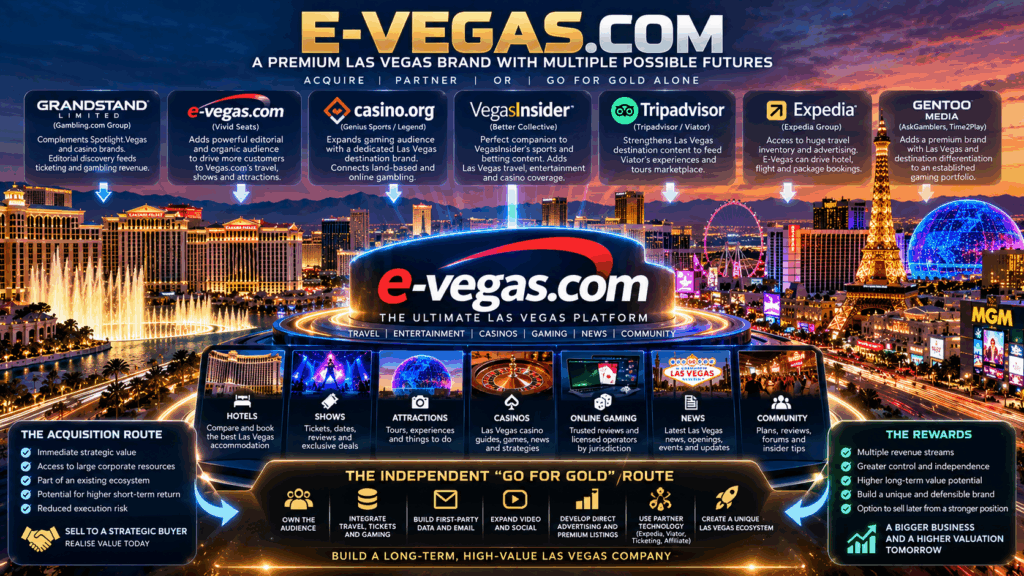
There are two very different ways to look at E-Vegas.com in 2026. The first is as an acquisition target: a long-established Las Vegas and gambling domain that could have unusual strategic value to companies such as Grandstand, Vivid Seats and Vegas.com, Genius Sports and Casino.org, Better Collective, Tripadvisor, Viator or Expedia. The second is more ambitious. Instead of asking which larger company ought to acquire E-Vegas.com, perhaps the more interesting question is what happens if E-Vegas refuses to become somebody else’s missing piece and attempts to build the missing platform itself.
That question becomes considerably more credible once the business models of the companies surrounding E-Vegas are examined closely.
Vegas.com demonstrates how valuable a dedicated Las Vegas transactional platform can become. Spotlight.Vegas demonstrates that specialist Las Vegas ticketing can be commercially valuable enough for a public company to acquire. Gambling.com and Casino.org demonstrate the economics of capturing high-intent gambling audiences before passing them to regulated operators. Tripadvisor and Viator demonstrate the power of separating travel discovery from transactional fulfilment while sharing the same commercial infrastructure. Expedia demonstrates that enormous travel inventory and fulfilment technology can increasingly be embedded into third-party platforms rather than requiring every publisher to become an online travel agency itself.
E-Vegas potentially sits where all of these models meet.
That does not mean success would be automatic, nor does it mean E-Vegas can simply copy businesses that have hundreds of employees, sophisticated technology and substantial capital. It means there is a conceivable strategy in which E-Vegas evolves beyond being primarily a publisher and affiliate into a specialised Las Vegas commerce and media ecosystem.
Before exploring that possibility, however, it is worth understanding why several much larger companies could reasonably take an interest in owning it.
Why Grandstand and Spotlight.Vegas Remain an Obvious Strategic Combination
The company formerly known as Gambling.com Group changed its corporate name to Grandstand Limited in July 2026. The rebrand was more than cosmetic. Grandstand now describes itself as operating across sports, gaming and entertainment, while Gambling.com remains one of its consumer-facing brands. Its wider portfolio includes Casinos.com, Gambling.com, RotoWire, OddsJam, OpticOdds and Spotlight.Vegas. Grandstand’s announcement explaining its corporate transformation makes clear that the company’s ambitions now extend substantially beyond conventional casino affiliate publishing.
The relevance to E-Vegas becomes particularly obvious through Spotlight.Vegas. Grandstand completed its acquisition of Spotlight in September 2025, paying an initial $8 million with up to a further $22 million available through performance-related earnouts. Spotlight connects customers with Las Vegas entertainment, attractions and experiences, giving Grandstand a transactional capability that its traditional gambling websites did not possess. Grandstand’s annual filing detailing the Spotlight.Vegas transaction shows just how deliberately the business entered the Las Vegas entertainment market.
Grandstand now explicitly identifies entertainment and tickets as one of its major partner solutions. Its corporate website says Spotlight.Vegas connects customers with shows, events and experiences in Las Vegas, alongside Grandstand’s separate businesses in sports data, advertising and audience monetisation. The company also maintains a physical Las Vegas operation housing the Spotlight team and focusing on entertainment and ticket partnerships. Grandstand’s current partner-solutions platform therefore describes almost exactly the infrastructure that could sit underneath a broader E-Vegas proposition.
This creates an unusually straightforward acquisition argument.
E-Vegas can attract people researching Las Vegas. Spotlight can sell something to those people.
If Grandstand owned both, it would control more of that journey.
Instead of E-Vegas functioning as an independent publisher that sends traffic into Spotlight through an affiliate relationship, it could become owned distribution. Grandstand could potentially integrate Spotlight inventory more deeply into E-Vegas editorial pages, coordinate ticket offers with search demand, create destination landing pages, develop email campaigns and use Grandstand’s wider advertising technology to monetise visitors who do not immediately buy tickets.
The case is even stronger because Grandstand already combines several monetisation systems. Its 2026 filings say performance-marketing revenue now includes CPA, revenue-share, hybrid and ticketing income, meaning the company has effectively begun combining gambling referrals and entertainment commerce inside one financial model.
E-Vegas could fit naturally inside that structure.
A visitor researching a casino game could generate gambling-affiliate revenue. A visitor researching a residency could generate ticket revenue. A visitor researching Las Vegas generally might be monetised through advertising, hotels, experiences or another commercial relationship.
Grandstand therefore has a logical reason to consider E-Vegas that extends far beyond domain ownership.
The Vegas.com Case May Be Even More Obvious
If Grandstand could use E-Vegas as the editorial layer above Spotlight.Vegas, then Vivid Seats could theoretically use it as the editorial layer above Vegas.com.
Vivid Seats acquired Vegas.com in November 2023 for approximately $248.3 million, consisting of roughly $152.8 million cash and $95.5 million in equity. Its filings describe Vegas.com as a marketplace covering Las Vegas shows, attractions, tours, flights and hotels. Vivid Seats’ annual filing covering the Vegas.com acquisition confirms both the purchase price and the breadth of the business.
That purchase price matters, although it should not be misinterpreted. It does not imply that another Las Vegas domain should be valued by reference to a quarter-billion-dollar transaction. Vegas.com is an established transactional marketplace with technology, supplier relationships, revenue and substantial operating infrastructure.
What it does prove is that Vivid Seats assigns enormous strategic importance to Las Vegas as a distinct commerce market.
Vegas.com occupies the lower part of the purchase funnel exceptionally well. Someone ready to buy a ticket, reserve an attraction or book part of a Las Vegas trip can transact directly.
E-Vegas could potentially operate further up that funnel.
Someone searching for the best shows in November is not necessarily ready to purchase immediately. Someone reading about the Sphere, a new casino resort, Formula 1, Fremont Street, a celebrity residency, the best blackjack casinos or the history of Caesars Palace may nevertheless become commercially valuable later.
Editorial media captures that earlier intent.
A combined proposition could therefore look less like two competing Vegas websites and more like two layers of the same commercial engine.
E-Vegas discovers, explains, compares, informs and inspires.
Vegas.com fulfils.
That is almost precisely the same distinction that Tripadvisor now describes between its own discovery platform and Viator’s transaction-oriented experiences marketplace. Tripadvisor’s 2025 annual report explains that Tripadvisor typically serves travellers in the discovery and planning phases while Viator serves customers with stronger booking intent. Both then share the same underlying inventory platform.
The logic is powerful because E-Vegas would not need to become Vegas.com in order to be valuable to Vegas.com.
It would need to become exceptionally good at creating the next Vegas.com customer.
There Is Also a Defensive Reason Vegas.com Could Care
Domain acquisitions sometimes have a strategic value unrelated to their current revenue.
If E-Vegas remained independent and small, it might represent limited competitive concern to Vegas.com. If E-Vegas were bought by Grandstand and connected directly to Spotlight.Vegas, the competitive position would change.
Grandstand could then own an editorial Las Vegas brand, a substantial casino affiliate operation and its own Las Vegas ticketing infrastructure.
If that ecosystem began attracting significant destination traffic, Vegas.com would face a competitor that controlled both media discovery and ticket conversion.
The same principle works in reverse. If Vivid Seats acquired E-Vegas and connected it to Vegas.com, Grandstand could lose an independent traffic source that might otherwise send visitors toward Spotlight.
This does not mean either company would acquire E-Vegas merely to prevent the other from owning it. It does mean strategic assets can become more valuable when ownership alters the competitive landscape.
There is only one Vegas.com.
There is only one E-Vegas.com.
That scarcity does not determine price by itself, but it matters once the underlying brand develops sufficient audience and commercial importance.
Casino.org Is Now Part of a Much Larger Genius Sports Story
Casino.org has also become considerably more interesting because its ultimate corporate context changed during 2026.
Genius Sports completed its acquisition of Legend in May 2026. Legend operates a large digital sports and gaming media portfolio that includes Casino.org, Covers.com and Casino Guru. Genius said those properties collectively generated approximately 320 million visits from 118 million unique visitors during 2025, with more than two-thirds of users returning regularly. Genius Sports’ announcement confirming completion of the Legend acquisition explains that the acquisition was intended to combine Genius’s existing sports-data infrastructure with large owned consumer audiences.
This matters because Genius did not acquire Legend simply to possess more SEO articles.
Its strategy is about audience ownership.
Genius already supplies data and technology to sports and betting businesses. Legend gives it direct access to consumers who are researching betting and gambling decisions. Those users create advertising inventory, affiliate opportunities, first-party audience information and repeated interaction.
E-Vegas could fit within that philosophy in a distinctive way.
Casino.org is naturally centred on casino gambling.
Covers.com occupies sports and betting.
Casino Guru has a broad international online-casino proposition.
E-Vegas could provide something geographically different: ownership of the Las Vegas destination itself as an editorial category.
That could cover land-based casinos, online gambling, casino resorts, live entertainment, hotel developments, major events, sport, restaurants, tourism and local business.
Such an acquisition would not merely duplicate Casino.org.
It could extend the portfolio into a different form of commercial intent.
A person reading about a Las Vegas resort may ultimately book accommodation, attend a show, purchase a sporting ticket or play online after returning home. The same visitor can move between physical and digital gambling in ways that a purely online casino publication may not capture as effectively.
For Genius, therefore, E-Vegas could become a bridge between gaming media and destination commerce.
Better Collective Has a Particularly Interesting Vegas Connection
Better Collective should not be ignored because it already owns VegasInsider.
The company describes itself as a digital sports media group operating a house of brands that includes Action Network, FUTBIN, HLTV, Playmaker HQ and VegasInsider. Better Collective says its portfolio collectively attracts more than 450 million monthly visits and monetises through multiple models including performance marketing, subscriptions, advertising and sponsorship. Better Collective’s current corporate overview gives a useful picture of the scale and diversity of the group.
VegasInsider itself is positioned as a recognised United States sports-betting brand providing odds, analysis, picks and data. Better Collective originally acquired VegasInsider.com and ScoresAndOdds.com for a combined $20 million in 2019, demonstrating that the company understands the strategic value of long-established gambling-related domains.
The potential relationship with E-Vegas is therefore unusually clean.
VegasInsider could remain focused on sport, odds and betting.
E-Vegas could focus on the destination, casinos, hotels, entertainment, experiences and broader Vegas economy.
During major events such as Formula 1, UFC weekends, Raiders games, March Madness, boxing events or the Super Bowl, those audiences naturally overlap.
Someone searching for odds before travelling to Las Vegas may subsequently need a hotel.
Someone attending a sporting event may want a show.
Someone visiting for a convention may gamble.
Someone researching Las Vegas casinos may also want sports-betting information.
The opportunity would be to connect those audiences rather than merge the brands.
Better Collective is currently experimenting with new forms of betting and prediction-market content through properties including VegasInsider, showing that the company continues to treat the brand as strategically important rather than merely maintaining it as a legacy asset.
Again, that does not prove acquisition interest in E-Vegas.
It demonstrates strategic compatibility.
Tripadvisor and Viator Present a Different Acquisition Thesis
Tripadvisor would value E-Vegas for a fundamentally different reason.
Its business strategy is increasingly centred around experiences. Tripadvisor now explicitly distinguishes between upper-funnel discovery and lower-funnel booking. Tripadvisor attracts users researching and planning trips, while Viator is designed around travellers ready to purchase tours, attractions and experiences. Both use Viator’s shared inventory and fulfilment platform, which includes supplier onboarding, inventory management, bookings, payments, fraud prevention and customer support.
That architecture is extraordinarily relevant to the E-Vegas question.
Imagine E-Vegas publishing what it already naturally publishes: guides to Las Vegas attractions, monthly entertainment, things to do, new openings, tours, landmarks and neighbourhoods.
Instead of simply linking those users away, E-Vegas could merchandise bookable products directly inside the editorial journey.
A guide to visiting Hoover Dam could offer tours.
An article about the Grand Canyon could display helicopter and coach experiences.
A Fremont Street guide could offer local attractions.
A Sphere article could surface relevant experiences.
A first-time Las Vegas guide could include a complete bookable itinerary.
This is precisely the economic logic Tripadvisor is pursuing globally: create demand through information and convert that demand through shared transactional infrastructure.
Tripadvisor may therefore be more interesting to E-Vegas as a partner than as an outright buyer.
That distinction becomes important in the final part of this analysis.
Expedia May Be More Valuable as Infrastructure Than as an Acquirer
Expedia creates the same possibility on a much larger travel-commerce scale.
Expedia Group’s B2B operation announced expanded technology in Las Vegas in May 2026 designed specifically to allow third parties to embed travel capabilities into their own products. Expedia says its B2B operation serves approximately 75,000 partners and 200,000 travel advisers, processing billions of API calls. The stated aim is to allow other businesses to build more complete travel experiences without constructing the underlying supply, pricing, payment and servicing infrastructure themselves. Expedia Group’s announcement about its expanded B2B travel platform is therefore highly relevant to any independent E-Vegas growth strategy.
Expedia is simultaneously expanding its advertising business. During the second quarter of 2026, Expedia Group Advertising generated $206 million of revenue, up 13% year on year, while the group has described advertising as a core growth engine.
That combination is important.
Expedia possesses hotels, flights, packages and other travel inventory.
It also possesses advertising infrastructure designed to monetise high-intent travellers.
E-Vegas potentially possesses the thing Expedia wants access to: people thinking about Las Vegas.
This raises an intriguing possibility.
E-Vegas may not need Expedia to buy it.
E-Vegas may need Expedia to power it.
That distinction leads directly to the larger strategic question.
What If E-Vegas.com Does Not Sell?
Suppose E-Vegas receives no acceptable acquisition offer.
Or suppose an offer arrives but undervalues what the platform could become.
There is another option.
E-Vegas could attempt to combine the best parts of Vegas.com, Spotlight.Vegas, Gambling.com and Casino.org while remaining independent.
The phrase “combine” needs to be understood carefully. It would be financially unrealistic for an independent publisher to replicate every piece of infrastructure those businesses possess. Vegas.com has transactional systems and supplier relationships. Genius Sports has substantial technology. Grandstand has public-market capital, sports data, advertising technology and international staff. Expedia operates global travel infrastructure.
E-Vegas does not have to reproduce those organisations.
It can reproduce the commercial architecture.
That is an entirely different proposition.
The E-Vegas Opportunity Is Really About Owning the Customer Journey
Traditional affiliate publishing frequently owns only one moment.
A user enters through Google.
The publisher recommends something.
The user clicks away.
The affiliate receives a commission.
The customer now belongs to somebody else.
That model can be profitable, but it limits the lifetime economic value of the visitor.
The bigger platforms have increasingly moved towards controlling several stages.
They attract the audience.
They collect first-party data with consent.
They recommend products.
They facilitate transactions.
They bring customers back.
They monetise the same audience across multiple categories.
That is the blueprint E-Vegas could borrow.
The objective would no longer be simply to rank an article for “best Las Vegas shows”.
The objective would be to own the relationship with somebody planning a Las Vegas trip.
That relationship could begin six months before departure and continue after the visitor returns home.
The economics are completely different.
E-Vegas Could Become the Discovery Layer
The first layer would remain editorial because this is where E-Vegas already has a natural advantage.
The ambition should be to become an enormous structured knowledge base about Las Vegas.
Every major casino.
Every hotel.
Every significant show.
Every residency.
Every attraction.
Every casino game relevant to the audience.
Every major sporting event.
Every significant convention.
Every major redevelopment.
Every new casino project.
Every meaningful restaurant opening.
Every transport option.
Every month of the year.
Every important neighbourhood and resort corridor.
The purpose is not simply content volume.
The purpose is to create thousands of commercially meaningful entry points into one underlying Vegas ecosystem.
A visitor researching “Las Vegas in November” should not land on an isolated article.
They should enter an interconnected environment.
That page can lead to November shows, hotel pricing, major events, weather, Formula 1 if relevant, casino promotions, attractions, dining and transportation.
Each page becomes a doorway rather than a dead end.
This is where the Casino.org and Gambling.com blueprint is particularly valuable.
Those businesses became powerful partly because they built deep topical structures around high-value consumer decisions.
E-Vegas can apply the same philosophy to an entire destination.
Then Add the Vegas.com Transaction Layer
The second layer is commerce.
This does not mean E-Vegas should immediately become the merchant of record for hotel rooms and tickets.
That would create unnecessary operational complexity involving payments, cancellations, customer support, chargebacks, refunds, supplier contracts and potentially additional regulatory obligations.
A far more intelligent first stage is embedded commerce.
Hotels can be supplied by established travel partners.
Tours can be supplied through existing experiences platforms.
Tickets can continue to come from specialist ticketing partners.
Casino referrals can continue through licensed affiliate programmes.
The difference is presentation.
Instead of putting an affiliate button beneath an article and hoping somebody clicks it, commerce becomes part of the product.
A user reading about a hotel could see current accommodation options.
A user researching a show could see upcoming performance dates.
A user reading a monthly entertainment guide could filter by date.
Someone researching a particular weekend could see everything happening during that stay.
The technological objective becomes to make E-Vegas feel transactional even while established partners handle fulfilment.
This is how a relatively small business can achieve some of the economics of a large marketplace without inheriting all of its operating costs.
Add Spotlight.Vegas-Style Specialist Ticketing
Entertainment deserves particular attention because Las Vegas is unusually suited to it.
Most destinations do not possess the concentration of permanent productions, residencies, headline concerts, comedy, magic, sports and attractions that Las Vegas does.
This creates recurring searchable inventory.
A show can have hundreds of performances.
A residency can generate news repeatedly.
New dates can be added.
Prices change.
Cast information changes.
Venues change.
Special offers appear.
That means E-Vegas could eventually build a structured entertainment database rather than treating every show as a conventional static article.
Imagine each production having a permanent entity page containing editorial description, venue information, current dates, ticket options, seating guidance, visitor reviews, related news and nearby restaurants.
The monthly show guide then pulls information from those entity pages.
Venue pages pull productions from the same database.
Artist pages connect to residencies.
News stories connect back to the commercial pages.
The resulting architecture starts looking much more like a platform than a blog.
That is one of the lessons to take from Spotlight.Vegas.
The valuable asset is not merely a page saying “buy tickets”.
It is structured commercial inventory surrounding entertainment demand.
Add the Gambling.com and Casino.org Monetisation Layer
The third component is gambling.
Las Vegas is unusual because gambling is simultaneously part of the destination, part of the culture and a separate online industry.
E-Vegas can therefore connect physical and digital casino content in a way that a conventional travel publisher cannot easily replicate.
A visitor may research blackjack rules before visiting Las Vegas.
They might want to understand roulette.
They could research the casino at Bellagio or Caesars Palace.
A UK visitor might subsequently search for a legal online casino after returning home.
Another reader may never travel to Nevada at all but associate E-Vegas with casino entertainment.
This allows distinct monetisation streams to coexist, provided they remain jurisdictionally appropriate and compliant.
Casino editorial should therefore not merely be bolted onto the travel operation.
It could form a parallel commercial vertical.
The important principle would be geographic separation and compliance. Gambling offers presented to a UK visitor, for example, must reflect UK rules and licensed operators. United States visitors require state-by-state consideration. Other jurisdictions need their own treatment.
This is one area where the expertise demonstrated by companies such as Grandstand, Genius and Better Collective becomes particularly relevant.
E-Vegas could eventually become both a Las Vegas travel authority and an international casino information brand, but those activities must be technically and editorially segmented where regulation requires it.
The Real Prize Is Cross-Monetisation
This is where the independent strategy becomes much more interesting than ordinary affiliate publishing.
A conventional Las Vegas travel site might earn commission on a hotel booking.
A conventional casino affiliate might earn CPA on a gambling customer.
A ticket affiliate may earn commission from a show.
E-Vegas can potentially encounter all three customers inside the same audience.
Imagine someone planning a four-night Las Vegas holiday.
They arrive through a Google search about the best time to visit.
They subscribe to a Las Vegas deals email.
They later return to compare hotels.
They reserve accommodation through an E-Vegas partner.
They purchase two show tickets.
They book a Grand Canyon excursion.
They read casino guides before travelling.
They click restaurant recommendations while in destination.
After returning to Britain, they continue receiving Vegas news and perhaps interact with appropriately regulated online casino content.
The commercial value of that individual could be many times greater than the revenue generated by the original Google click.
This is the fundamental difference between traffic monetisation and audience monetisation.
Grandstand itself is explicitly moving in this direction. Its partner platform describes audience monetisation as putting an existing audience to work across affiliate programmes, targeted promotions, ticketing and other products.
E-Vegas can learn from that without becoming Grandstand.
Build a Real E-Vegas Account
One of the most important long-term changes would be moving beyond anonymous website traffic.
Users could create an E-Vegas account.
Initially the reason needs to be useful rather than artificial.
Save favourite shows.
Create a Las Vegas itinerary.
Watch hotel prices.
Save restaurants.
Receive alerts when new residency dates are announced.
Build a casino wish list.
Receive personalised “what’s happening during your dates” updates.
Store ticket links.
Create a shareable itinerary for a group.
Once somebody voluntarily identifies themselves, E-Vegas is no longer entirely dependent upon Google rediscovering that customer.
That matters enormously.
Grandstand revealed in its second-quarter 2026 results that approximately two-thirds of its marketing revenue was already coming from non-SEO sources, an important response to the volatility the company has experienced from search-engine algorithm changes.
The lesson is directly applicable to E-Vegas.
Google should remain an acquisition channel.
It should not remain the customer database.
Email Could Become One of the Most Valuable E-Vegas Assets
For a Las Vegas brand, email has unusually strong potential because the destination constantly changes.
New shows are announced.
Residencies add dates.
Casinos open.
Restaurants close.
Hotel offers change.
Formula 1 returns.
Sphere changes productions.
Sporting events are announced.
Convention calendars move.
A weekly E-Vegas newsletter could therefore become a genuine media product rather than a list of affiliate offers.
More importantly, segmentation creates commercial intelligence.
Someone who clicks magic-show content repeatedly can receive relevant entertainment updates.
Someone researching hotels for February could receive February-specific events.
Someone following Formula 1 can receive race-week information.
Someone primarily interested in casinos could receive a different stream.
That is the beginning of a first-party audience business.
The value of E-Vegas then becomes less dependent upon where one particular keyword ranks tomorrow morning.
Video and Social Should Become Distribution, Not Promotion
Another mistake affiliate businesses frequently make is treating social media as somewhere to paste links to articles.
E-Vegas should treat video, Shorts, Facebook, Instagram, TikTok and YouTube as independent audience-acquisition channels.
Las Vegas is almost uniquely visual.
Casino floors.
Hotels.
New attractions.
Shows.
The Strip.
Downtown.
Supercars.
Restaurants.
Celebrity appearances.
Construction.
Major openings.
Formula 1.
Sphere.
There is effectively endless source material.
A strong E-Vegas editorial operation can therefore create one story in multiple formats.
A new resort opening can become a long-form article, news update, YouTube feature, Short, Facebook post, image gallery, newsletter item and destination-guide update.
All those channels then feed the same underlying commerce platform.
That is how E-Vegas begins reducing its dependence on SEO while simultaneously making the brand itself more recognisable.
News.E-Vegas Could Become a Serious Asset
The news operation deserves to be viewed separately from evergreen affiliate content.
Las Vegas has a constant news cycle involving casino companies, hospitality businesses, sport, entertainment, construction, transport, real estate and tourism.
News provides something evergreen content cannot easily provide: frequency.
Someone may search “best Las Vegas hotel” once.
They might read Vegas news every week.
That difference matters because frequency creates a relationship.
A dedicated E-Vegas news operation could eventually function as the daily top of the funnel while the main E-Vegas platform handles deeper guides and commerce.
News stories could connect directly into structured commercial entities.
A new residency announcement links to the artist page, venue page and eventual ticket inventory.
A casino renovation links to the resort profile.
A restaurant opening links to the hotel and dining guide.
A new attraction links to booking inventory.
News stops being disposable content.
It becomes a continuous update mechanism for the underlying E-Vegas knowledge graph.
Local Las Vegas Businesses Create Another Revenue Layer
There is also an opportunity that the large international gambling affiliates are less naturally positioned to exploit.
Las Vegas has thousands of locally relevant commercial businesses competing for visitor attention.
Restaurants.
Limos.
Wedding chapels.
Nightclubs.
Pool parties.
Car rentals.
Supercar experiences.
Shooting ranges.
Tours.
Helicopters.
Photographers.
Golf.
Spas.
Tattoo studios.
Retail.
Event services.
Independent attractions.
A properly developed E-Vegas business directory could create advertising, premium listing and lead-generation revenue.
The key would be maintaining editorial integrity.
Payment should improve commercial presentation or placement where clearly disclosed; it should not secretly determine editorial recommendations.
If that distinction is respected, a destination authority can operate both editorial and commercial directory products successfully.
The resulting business becomes much broader than gambling affiliate marketing.
E-Vegas Could Eventually Become a Las Vegas Advertising Network
Once audience scale develops, direct advertising becomes increasingly important.
Expedia’s strategy illustrates why travel audiences themselves have value independent of immediate bookings. Expedia Group Advertising generated hundreds of millions of dollars of annual revenue and is actively expanding beyond traditional travel advertisers because people planning trips are commercially valuable across many categories.
E-Vegas could develop a specialised version of that principle.
A person planning Las Vegas is potentially valuable to airlines, card companies, luggage brands, fashion companies, restaurants, casinos, entertainment venues, financial products, insurance providers and local businesses.
At sufficient scale, E-Vegas inventory could command more value sold directly than through generic display advertising networks.
Sponsored destination guides, newsletter placements, event sponsorships, branded video and category partnerships could become meaningful revenue streams.
That is another important transition.
Affiliate businesses earn money when somebody completes a defined action.
Media businesses can earn money simply because they possess a valuable audience.
The strongest E-Vegas model would eventually do both.
International Expansion Could Be Particularly Powerful
Las Vegas is an American destination with a global audience.
That creates another advantage.
E-Vegas does not necessarily need separate brands for Britain, Germany, Canada, Australia or other major source markets.
The main destination remains the same.
What changes is the traveller.
A UK visitor needs information about ESTA requirements, flight options, tipping, resort fees, currency, driving and gambling rules.
A Canadian visitor has different logistics.
A domestic American visitor may care more about airline routes, state gambling rules or weekend packages.
Translation and localisation could therefore expand E-Vegas internationally while preserving one central brand.
Grandstand already operates consumer marketing across more than 20 national markets and more than 10 languages, demonstrating how gambling audiences can be localised while using shared underlying technology.
The same concept can be applied to travel.
Not merely translate the words.
Localise the journey.
AI Could Make the Platform Much More Useful — If Used Correctly
An E-Vegas AI product should not simply generate generic articles.
Its strongest use would be personalised navigation of verified E-Vegas data.
A visitor could ask:
“What can two adults do in Las Vegas from 12 to 16 November for under $1,000 excluding hotel?”
“Which Cirque shows are playing while I’m there?”
“Find three restaurants near Caesars Palace before my 8pm show.”
“What is happening during Formula 1 weekend?”
“Build me a four-day first-time Vegas itinerary.”
The AI layer would then draw from structured E-Vegas content, current partner inventory, opening hours and verified event information.
That creates utility rather than content spam.
If E-Vegas eventually possesses structured information about hotels, casinos, restaurants, attractions, venues, shows and events, conversational discovery becomes a natural interface over that database.
The website then begins to resemble a Vegas operating system.
The Long-Term Vision Is Not Another Affiliate Site
This distinction is crucial.
If E-Vegas remains a collection of articles that occasionally send visitors to another website, the addressable opportunity is limited.
If E-Vegas becomes the place where someone starts planning Las Vegas, returns repeatedly during the planning process, saves a trip, receives recommendations, checks events, purchases experiences and continues consuming Vegas media afterwards, the nature of the business changes fundamentally.
It becomes part publisher.
Part comparison engine.
Part entertainment guide.
Part casino information platform.
Part travel marketplace.
Part local-business directory.
Part news organisation.
Part audience-data business.
The fulfilment behind many of those services can initially belong to partners.
E-Vegas owns the customer relationship.
That is the gold.
Why Going Alone Could Ultimately Increase Acquisition Value
There is an irony in the decision between selling and remaining independent.
The best way to create a significantly larger acquisition opportunity may be not to sell yet.
Today, a buyer could examine E-Vegas through the conventional framework of traffic, affiliate revenue, backlinks, domain value and content.
If E-Vegas successfully develops ticketing integration, hotel commerce, email subscribers, repeat visitors, direct advertising, social reach, proprietary data and structured destination inventory, the valuation conversation changes.
The company is no longer buying pages.
It is buying distribution.
It is buying customers.
It is buying first-party audience.
It is buying transaction volume.
It is buying a recognised destination platform.
That can attract an entirely different class of strategic interest.
It also creates leverage for the seller.
A business dependent upon one affiliate network has limited negotiating power.
A business capable of switching ticket providers, hotel providers, advertising partners and casino operators has considerably more.
Vertical diversification can therefore increase both revenue and strategic independence.
There Is a Significant Difference Between Selling Traffic and Owning Demand
This may be the single most important concept in the entire E-Vegas strategy.
Traffic is temporary.
Demand is structural.
Millions of people will continue wanting to visit Las Vegas.
They will continue looking for hotels.
They will continue searching for shows.
They will continue gambling.
They will continue researching restaurants and attractions.
Search engines may change how those questions are answered, but the underlying consumer demand remains.
The strategic objective is therefore not to “own a Google ranking.”
It is to become one of the brands people associate with satisfying Las Vegas demand.
Vegas.com achieved this from a transactional direction.
Casino.org and Gambling.com achieved something similar around gambling information.
Tripadvisor achieved it through travel discovery.
E-Vegas has the unusual semantic advantage of a name capable of stretching across all of those categories.
That is potentially its most important asset.
But Going for Gold Carries Much Greater Risk
The independent strategy should not be romanticised.
It would require considerable execution.
Technology would need improvement.
Content quality would need to remain consistently high.
Commercial relationships would need professional management.
Analytics and attribution would need strengthening.
Regulatory compliance would become more complicated as additional gambling markets were targeted.
Email, privacy and consent systems would need proper governance.
Structured data would require engineering.
Partner feeds can fail.
Pricing can become stale.
Large-scale travel commerce creates customer expectations even where a third party fulfils the transaction.
Direct advertising requires sales capability.
Editorial expansion requires journalists, editors and destination expertise.
And every additional business line creates operational complexity.
There is also the constant danger of attempting to build everything at once.
E-Vegas does not need to become Vegas.com, Tripadvisor, Expedia, Casino.org and Gambling.com simultaneously.
The correct strategy would be sequential.
Start with the audience.
Improve the product.
Integrate commerce.
Capture first-party relationships.
Increase repeat visits.
Develop direct revenue.
Then expand.
The Asset-Light Model Is Probably the Sensible Path
The most realistic E-Vegas strategy is therefore not massive vertical integration from day one.
It is asset-light vertical coordination.
E-Vegas should own what creates differentiation.
The brand.
The domain.
The audience.
The editorial voice.
The destination database.
The customer relationship.
The first-party data collected with permission.
The technology connecting those things.
Commodity infrastructure can initially come from partners.
Hotel inventory does not need to be owned.
Ticket fulfilment does not need to be owned.
Payments do not necessarily need to be processed internally.
Tours do not need to be operated by E-Vegas.
Casino games obviously do not need to be provided by E-Vegas.
This dramatically reduces capital requirements.
The company can behave like a marketplace while remaining, initially, a sophisticated distribution and media platform.
Only when sufficient transaction volume exists would there be a reason to consider internalising additional parts of the value chain.
This Is Where Expedia’s 2026 Strategy Is Particularly Important
Expedia is effectively encouraging businesses to adopt this approach.
Its B2B platform is designed to allow partners to incorporate travel products without rebuilding global travel infrastructure themselves. Expedia explicitly talks about allowing partners to capture more of the trip through one technology connection.
That principle is exactly what E-Vegas needs.
Do not build Expedia.
Connect Expedia-like infrastructure to E-Vegas.
Do not build Viator.
Connect experience inventory.
Do not initially build Spotlight.
Integrate ticketing.
Do not build an online casino.
Refer users to licensed operators.
The scarce asset E-Vegas should concentrate on owning is the audience relationship.
Everything else can be bought, licensed, syndicated, integrated or partnered until scale justifies deeper investment.
A Future E-Vegas Could Be Worth More Than the Sum of Its Parts
This is ultimately why the sell-versus-build question is so interesting.
Grandstand could see E-Vegas as a media funnel for Spotlight.
Vivid Seats could see it as a discovery funnel for Vegas.com.
Genius Sports could see it as a Las Vegas audience extension to Casino.org.
Better Collective could see it as a destination companion to VegasInsider.
Tripadvisor could see it as specialised travel discovery.
Expedia could see it as a distribution partner.
Each prospective partner sees only part of the opportunity because each already owns the other part.
E-Vegas potentially has the option of assembling those parts itself.
Not by purchasing billion-dollar infrastructure.
By connecting existing platforms beneath one consumer brand.
That creates a fascinating strategic possibility.
The businesses most likely to understand E-Vegas’s value are simultaneously examples of how E-Vegas could become more valuable without them.
The Ultimate Decision Is Really About Timing
There is therefore no contradiction between believing Grandstand, Vivid Seats or Genius Sports could be logical buyers and believing E-Vegas should explore independent growth.
Both can be true.
The acquisition question is ultimately a comparison between two numbers.
The first is what a strategic buyer is prepared to pay today.
The second is the risk-adjusted future value that can realistically be created by remaining independent.
If a buyer offers a price reflecting only existing affiliate profit, domain value and current traffic, selling could sacrifice substantial optionality.
If a buyer recognises the strategic value of combining E-Vegas with an existing ticketing, gambling or travel platform and pays accordingly, acquisition becomes much more compelling.
The owner’s bargaining position improves significantly if there is a credible alternative to selling.
That alternative is not simply “keep running the website.”
It is to build the platform.
The Most Powerful E-Vegas Pitch May Eventually Be: We Don’t Need to Sell
That position changes negotiations completely.
Imagine approaching Grandstand while E-Vegas is dependent upon Spotlight for monetisation. Grandstand possesses substantial leverage.
Now imagine approaching Grandstand after E-Vegas has hotel integration, several ticketing options, a large email database, substantial direct traffic, direct advertiser relationships, social distribution and measurable transaction volume.
E-Vegas can continue without them.
The same applies to Vegas.com.
The same applies to Genius.
The same applies to Expedia.
Strategic acquirers frequently pay the highest premiums for assets they cannot easily replicate and whose owners do not need to sell.
Independence can therefore be part of acquisition strategy.
Could E-Vegas Really Challenge Vegas.com?
It would be misleading to suggest that an independent E-Vegas can simply decide to overtake Vegas.com.
Vegas.com was acquired for approximately $248 million and benefits from Vivid Seats infrastructure, supplier relationships, marketing capability and considerable capital.
But E-Vegas does not need to beat Vegas.com at everything.
It needs to create areas where its proposition is better.
More editorial depth.
More casino expertise.
Better international coverage.
Better news.
More comprehensive monthly entertainment.
Stronger integration between online gambling and physical Vegas.
Better community.
More personality.
Better niche search coverage.
Better video.
Better trip-planning tools.
A destination challenger rarely wins by reproducing the incumbent exactly.
It wins by serving parts of the customer journey the incumbent treats as secondary.
Could E-Vegas Challenge Casino.org or Gambling.com?
Again, not by trying to become a generic casino affiliate.
Those companies possess immense authority, commercial infrastructure and international scale.
E-Vegas has a different potential advantage.
It owns a destination identity.
That allows gambling content to exist inside something larger.
Casino.org can explain roulette.
E-Vegas can explain roulette, show where to play it in Las Vegas, discuss the casinos, explain the destination, recommend the hotel, identify the shows happening afterwards and potentially continue the relationship when the visitor goes home.
The breadth is the opportunity.
Provided that breadth is organised rather than chaotic.
Could E-Vegas Become Bigger Than a Pure Affiliate Business?
This is perhaps the most consequential question.
Potentially, yes.
Travel, entertainment, advertising, ticketing, local business and gambling offer substantially more monetisation routes than casino affiliate revenue alone.
More importantly, several of them are uncorrelated.
A regulatory change affecting online casino CPA does not eliminate hotel demand.
A Google update affecting one gambling content cluster does not remove direct newsletter traffic.
Weak ticket sales do not necessarily affect travel advertising.
A change in one operator agreement does not destroy local-business revenue.
Diversification therefore has strategic value beyond growth.
It makes the business more resilient.
That same diversification is exactly what Grandstand itself has been pursuing. The company now combines sports data, gambling marketing, advertising, ticketing and audience monetisation, and reported in 2026 that non-SEO sources represented roughly two-thirds of its marketing revenue.
There is an important lesson there for E-Vegas.
Do not merely become bigger.
Become harder to kill.
What E-Vegas Could Ultimately Become
The most ambitious version of E-Vegas is not an affiliate site and not simply an online travel agency.
It is the digital front door to Las Vegas.
Someone deciding whether to visit enters through E-Vegas.
Someone planning a trip uses E-Vegas.
Someone choosing a hotel researches it on E-Vegas.
Someone comparing casinos uses E-Vegas.
Someone checking what’s on during their stay uses E-Vegas.
Someone purchasing a show can do so through E-Vegas-connected inventory.
Someone looking for attractions can book through E-Vegas.
Someone following Las Vegas news reads E-Vegas.
Someone interested in casino gaming can use E-Vegas internationally where appropriate.
Someone already in Las Vegas can open E-Vegas to decide what to do that night.
That is considerably more ambitious than ranking an affiliate page.
It is also why the domain matters.
“E-Vegas” naturally describes precisely that concept: an electronic or digital Vegas.
A digital version of the destination.
Sell the Website — Or Build the Company?
That may ultimately be the real decision.
If E-Vegas is regarded as a website, an acquisition could be an attractive exit.
If it is regarded as the foundation of a much larger Las Vegas digital company, selling the domain today means selling the option to build that company.
Neither decision is automatically correct.
Building carries execution risk, capital risk, search risk, regulatory risk and substantial opportunity cost.
Selling converts future uncertainty into present value.
But there is now enough evidence from surrounding businesses to demonstrate that the underlying strategy is not fanciful.
Vivid Seats spent hundreds of millions acquiring Vegas.com.
Grandstand bought Spotlight.Vegas and now explicitly combines gambling performance marketing with ticketing.
Genius Sports spent heavily to acquire owned media audiences including Casino.org.
Tripadvisor is deliberately combining discovery and transaction through Tripadvisor and Viator.
Expedia is building infrastructure specifically so outside brands can integrate travel commerce.
Better Collective has demonstrated for years that premium gambling and sports media domains can be acquired, developed and monetised as a portfolio.
These companies have independently constructed different pieces of the same machine.
E-Vegas has the unusual possibility of assembling those pieces around one of the world’s most commercially recognisable destinations.
The biggest opportunity may therefore not be finding the company that wants to buy E-Vegas.
It may be discovering what E-Vegas becomes when it starts behaving like the companies that might want to buy it.
And if that strategy succeeds, the acquisition conversation does not disappear.
It becomes considerably more interesting.
Because at that point Grandstand would not be considering the purchase of another affiliate website.
Vivid Seats would not be considering another Las Vegas domain.
Genius Sports would not be considering another content publisher.
They would potentially be considering the acquisition of an independent Las Vegas audience, media, gambling, entertainment and commerce platform sitting directly between millions of consumers and billions of dollars of annual destination spending.
That is a very different asset.
And that is what “going for gold” could actually mean for E-Vegas.com.