The Magical World Famous Empire That Is Modern-Day Las Vegas
The Magic of Las Vegas: What Makes Vegas Magical, Why It Means Something Different to Everyone, and Can That Magic Really Be Captured Online?
Las Vegas has always been more than a destination. For some, it is a city of dreams, glamour and extraordinary entertainment. For others, it represents freedom, opportunity, nostalgia, romance or the excitement of the unexpected. But what do people really mean when they talk about “Magical Vegas” or the “magic of Las Vegas”? And in an increasingly digital world, can something so deeply personal and emotional be recreated through a website, an online casino, a live entertainment platform or a virtual experience?
There is something about Las Vegas that has fascinated generations of people, including millions who have never actually visited the city. Its name alone can conjure images of illuminated boulevards, legendary casinos, spectacular performances, extravagant hotels and a world where ordinary expectations are temporarily suspended. Few destinations possess quite the same ability to transport someone’s imagination thousands of miles without that person ever leaving their home.
Yet ask ten people what makes Las Vegas magical and you may receive ten entirely different answers. One might remember standing beneath the neon lights of Fremont Street on their first visit. Another might describe watching the Bellagio fountains with someone they love. Someone else could recall a Frank Sinatra recording, a childhood memory of seeing Elvis Presley on television, or the extraordinary anticipation of walking through the doors of Caesars Palace for the first time.
For others, their first meaningful connection with Las Vegas may never have involved travelling to Nevada at all. It might have begun with a movie, a video game, an online casino, a televised boxing match, a spectacular concert or even a social media video showing the Strip glowing against the desert sky.
That raises a fascinating question. If the magic of Las Vegas exists as much in our imagination as it does in the physical city, does someone actually have to visit Las Vegas to experience a little of it?
Perhaps the real magic of Las Vegas is not simply what the city offers, but what it makes people feel.
What Does the Magic of Las Vegas Actually Mean?
The word magic is traditionally associated with the impossible, with illusion, wonder and the appearance of something extraordinary happening before our eyes. Las Vegas has built much of its worldwide reputation on precisely these qualities, although not always through traditional magic shows or theatrical illusions.
The city offers an extraordinary contrast between expectation and reality. In the middle of the Mojave Desert, a place historically associated with vast empty landscapes and extreme conditions, stands one of the most elaborate entertainment destinations ever created. Its architecture borrows inspiration from ancient Rome, Paris, Venice, New York and countless other places, transforming familiar cultural references into larger-than-life experiences.
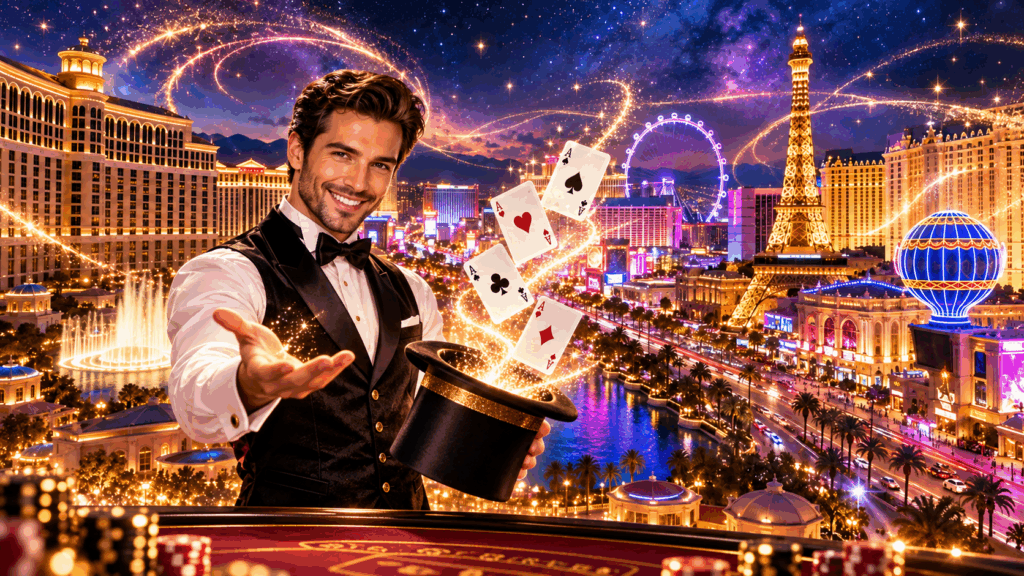
Visitors can walk along the Strip beneath an illuminated Eiffel Tower, explore the canals of a Venetian-inspired resort, encounter Egyptian-themed architecture or watch enormous fountains performing in synchronisation with music. The effect is intentionally theatrical. Las Vegas is a place where reality is frequently reinvented, often for the simple pleasure of creating something memorable.
It is this apparent disregard for ordinary limitations that helps explain the city’s appeal. Las Vegas does not merely invite visitors to observe its attractions. It encourages them to become part of an experience that feels removed from everyday life.
That psychological separation is important. People do not necessarily travel to Las Vegas because they want to see something realistic. They frequently go because they want something completely different from reality.
The Las Vegas Convention and Visitors Authority has built much of the destination’s identity around experiences that are difficult to replicate elsewhere, from headline entertainment and extraordinary dining to ambitious attractions and uniquely theatrical celebrations.
But beyond the marketing lies something much more personal. To many visitors, the city’s greatest attraction is the temporary freedom to experience life differently.
Magical Vegas Means Something Different to Every Person
For one visitor, Las Vegas represents luxury and achievement. They might have spent years imagining themselves walking into a magnificent hotel, ordering dinner at a celebrated restaurant, watching a world-famous performer or enjoying a room overlooking the Strip. Their interpretation of the magic is associated with success, reward and the experience of something they once considered beyond their reach.
For another, Las Vegas represents adventure. They are attracted not necessarily by expensive accommodation or glamorous restaurants, but by the possibility of encountering something unexpected. They want to explore the city after dark, discover unusual attractions, meet new people and experience the spontaneity for which Las Vegas has become famous.
For couples, the magic may be romantic. A marriage proposal, an anniversary, a honeymoon or even a spontaneous wedding can turn an ordinary holiday into a defining personal memory. Las Vegas has a remarkable ability to accommodate both extravagant romantic gestures and charmingly unconventional celebrations, often within the same neighbourhood.
For families, the experience may revolve around elaborate swimming pools, themed attractions, musical performances, incredible restaurants, sporting events and the wonder of seeing a city unlike anything they have previously encountered. Children and adults can take away completely different memories from the same visit, yet both may describe their experiences as magical.
For an enthusiast of classic Las Vegas, the meaning can be almost entirely nostalgic. The magic belongs to the era of the Rat Pack, illuminated marquees, intimate casino lounges, lavish showrooms and legendary resorts. The old photographs, recordings and preserved signs can create an emotional connection with a Las Vegas that no longer exists in quite the same form.
The Neon Museum in Las Vegas understands this connection particularly well. By preserving historic casino and hotel signage, it protects much more than advertising. It preserves pieces of the city’s identity, allowing visitors to reconnect with the personalities, architecture and stories that shaped its reputation.
What makes this fascinating is that nostalgia for Las Vegas is not limited to people who experienced its earlier eras. Someone born decades after the height of the Rat Pack can still develop a powerful emotional attachment to the glamorous version of the city portrayed in old films, photographs and television programmes.
The Las Vegas that exists in somebody’s imagination can become just as meaningful to them as the physical destination.
The Magic Is Often About Possibility Rather Than What Actually Happens
Perhaps one of Las Vegas’s most distinctive qualities is its association with possibility. The city has traditionally offered a combination of entertainment, personal reinvention, chance and spectacle that encourages people to imagine events unfolding differently from everyday life.
A visitor might arrive hoping to meet someone special, attend the performance of a lifetime, discover an unexpected opportunity or simply return home with an extraordinary story. The anticipation of these possibilities can become an important part of the experience itself.
Gaming has historically played a role in this perception. Casino floors, slot machines, roulette wheels, blackjack tables and the imagery of jackpots are deeply embedded in popular representations of Las Vegas. For many people, the casino environment symbolises suspense, excitement and the uncertainty of what comes next.
However, there is an important difference between the emotional attraction of possibility and the mathematical realities of gambling. Casino games are governed by defined rules, probabilities and, in most cases, a house advantage. No amount of atmosphere, anticipation or belief in the magic of Vegas changes those underlying facts.
This distinction helps explain why the emotional idea of Las Vegas is considerably bigger than gambling. Someone who never places a bet can experience the same sense of anticipation while waiting for the curtain to rise on a spectacular performance, entering an unfamiliar attraction or exploring a famous hotel for the first time.
What unites these activities is not the possibility of winning money. It is the possibility of experiencing something memorable.
Las Vegas: A City Where Entertainment Becomes an Experience
To understand the magic of Las Vegas, it is essential to understand the difference between watching entertainment and experiencing it.
A concert can take place almost anywhere, but Las Vegas has spent generations developing environments in which the location, venue, artist and production become part of a much larger spectacle. The city’s entertainment heritage stretches from legendary performers such as Frank Sinatra, Dean Martin, Sammy Davis Jr. and Elvis Presley through to contemporary residencies, elaborate theatrical productions and extraordinary technology-led attractions.
Illusionists and magicians have also contributed directly to the city’s identity. Performers such as Siegfried & Roy, David Copperfield and Penn & Teller have demonstrated how theatrical magic can become inseparable from the broader mythology of Las Vegas. As explored in the Neon Museum’s history of Siegfried & Roy, extraordinary performances helped define entire periods of the city’s entertainment history.
Yet the magic extends far beyond the performers themselves. It exists in the anticipation before a show, the architecture of the theatre, the excitement of the audience and the memory that remains long after the performance has ended.
Modern attractions have taken this philosophy even further. Sphere in Las Vegas uses enormous immersive displays, advanced audio and ambitious visual storytelling to create entertainment environments that would have seemed impossible to previous generations.
Meanwhile, the Fremont Street Experience demonstrates how an entire public space can be transformed into a theatrical setting through digital imagery, sound, lighting and communal participation.
These attractions reveal something important about Las Vegas. The city has never depended exclusively on preserving traditional forms of entertainment. It has continually adopted new technologies to reinvent the feeling of wonder.
In many respects, Las Vegas was creating immersive entertainment experiences long before the terminology became fashionable in the technology industry.
Can You Experience the Magic of Las Vegas Without Actually Going There?
This is where the meaning of Magical Vegas becomes particularly interesting.
There is a significant difference between physically visiting Las Vegas and forming an emotional connection with the destination. Yet it would be wrong to suggest that the latter is somehow less genuine.
Millions of people develop meaningful connections with places they have never visited. Film, television, music, photography and literature have always enabled individuals to experience distant destinations through other people’s interpretations.
Las Vegas is particularly suited to this form of cultural connection because its visual identity is instantly recognisable. An illuminated casino entrance, a roulette table, an Elvis impersonator, a dancing fountain or a panorama of the Strip can immediately establish a sense of place.
Even the sounds associated with Las Vegas carry meaning. The atmosphere of a casino, the excitement of a live audience, the music of a legendary performer and the background activity of a bustling entertainment district can make a distant place feel surprisingly immediate.
Digital technology has dramatically expanded these possibilities. Today, people can watch live performances, explore hotels through interactive tours, follow Las Vegas news, compare entertainment experiences, discover historic photographs and interact with communities of enthusiasts without ever booking an airline ticket.
The result is not an exact replacement for being physically present. A screen cannot reproduce every sensation associated with a city, including its scale, temperature, smells, crowds and spontaneous encounters.
Nevertheless, it can capture something equally important: the emotional relationship between the audience and the destination.
A person watching footage of the Las Vegas Strip from a small town in England might feel the same anticipation and excitement that first inspired someone else to visit Nevada decades earlier. That emotion exists independently of geography.
The experience may be different, but the connection can still be real.
Magical Vegas in the World of Online Casino Gaming
The phrase Magical Vegas also has a more specific commercial meaning because Magical Vegas is the name of an established online casino brand serving the British market.
The operator’s own description of the brand provides an interesting example of how the emotional identity of Las Vegas can be translated into a digital gaming environment. Its marketing draws upon the bright lights, glamour, history and excitement associated with the destination, encouraging customers to experience elements of that atmosphere through their personal devices.
Its longstanding brand message, “Bring Home The Magic,” neatly captures the commercial appeal of recreating a Las Vegas-inspired experience away from Nevada.
Operated by Rank Interactive (Gibraltar) Limited, which holds UK Gambling Commission licences, Magical Vegas demonstrates how a destination’s identity can inspire an entirely digital entertainment product.
But this example also raises a broader question. Is bringing a selection of casino games to someone’s mobile phone enough to reproduce the magic of Las Vegas?
For some customers, the answer may be yes, at least in part. If their primary attraction to Las Vegas is the atmosphere of casino gaming, familiar card games, themed slots and the anticipation associated with playing them, an online casino can provide a recognisable connection to that experience.
Others might argue that the casino floor is only one small component of what makes Las Vegas special. Without the hotels, performances, restaurants, history, architecture, personalities and spontaneous human interactions, something essential is inevitably missing.
Both perspectives can be valid because they reflect different personal interpretations of the destination.
The important lesson for digital businesses is that the words Vegas and magical can create an emotional expectation, but that expectation must be supported by the actual experience delivered to the customer.
Simply adding neon graphics, casino imagery or familiar Las Vegas terminology to a website does not automatically make the platform immersive, memorable or distinctive.
There is also an important boundary between entertainment and financial reality. Online casino experiences should provide clear information about the games being offered, applicable licensing, player protections and the risks involved. Digital excitement should never depend on misleading players about their chances of winning.
Live Casino Gaming: Does a Real Person Make the Experience Feel More Like Vegas?
The development of live dealer casino gaming offers another interesting example of the relationship between technology and human experience.
Traditional online casino games primarily rely on software to simulate the appearance and mechanics of games such as blackjack, roulette and baccarat. Modern live dealer platforms introduce real presenters, physical gaming equipment, studio environments and video streams, creating a more socially recognisable experience.
The presence of a human dealer can fundamentally change how a participant perceives the activity. Instead of interacting exclusively with a computer-generated interface, the user sees a real person managing the game and, where supported, communicating with participants.
This introduces elements of personality, theatre and human interaction that have always been associated with traditional casino environments.
However, a live casino experience should not automatically be confused with a gaming broadcast from a physical casino in Las Vegas. Many live dealer products are produced in dedicated studios elsewhere in the world, and the location of a broadcast should be represented accurately.
The distinction matters because authenticity is part of the experience. A genuine broadcast from a recognised Las Vegas location may appeal to visitors and enthusiasts for different reasons than a professionally produced casino game using Las Vegas-inspired scenery.
Both can offer digital entertainment, but they are not interchangeable.
In the future, the integration of interactive video, virtual environments and more sophisticated social technology may create additional ways to connect audiences with recognisable Las Vegas settings. For the strongest destination-oriented platforms, however, the opportunity extends far beyond placing a virtual casino table on a screen.
The Real Digital Opportunity Is to Recreate the Feeling, Not Simply the Appearance
A digital platform attempting to capture the magic of Las Vegas faces a fundamental creative decision. Should it reproduce the visual symbols of the city, or should it attempt to reproduce the emotional experience those symbols represent?
The distinction is enormous.
Anyone can build a website with photographs of casino resorts, illuminated buttons, animated playing cards and a background image of the Strip. These design features may establish a recognisable theme, but they do not necessarily create a memorable experience.
The more sophisticated approach begins by asking why people are attracted to Las Vegas in the first place.
If a visitor associates Las Vegas with discovery, the digital platform should help them uncover places, experiences and stories they did not previously know existed. If their attraction is nostalgia, it should allow them to revisit historic resorts, legendary performers and iconic moments through carefully curated editorial content, photographs and archive material.
If they are interested in luxury, the platform might help them explore magnificent hotels, exclusive dining experiences and extraordinary accommodation. If their passion is entertainment, it should connect them with artists, productions, venues, previews, interviews and genuine opportunities to attend performances.
For someone who has never visited the city, a compelling digital experience could begin with a simple question: what does your perfect Las Vegas look like?
The answer could lead to an entirely personalised exploration, whether that involves romantic evenings, historic casinos, live music, spectacular shows, family adventures, luxury resorts or the distinctive atmosphere of Downtown Las Vegas.
This is how a digital platform can move beyond merely presenting information and begin creating a meaningful relationship with its audience.
The technology becomes the means of delivering that relationship, rather than the reason the relationship exists.
From Online Gaming to a Complete Digital Las Vegas Experience
Imagine a digital platform that treats Las Vegas not merely as a collection of businesses, but as a constantly evolving world of entertainment, history, travel and culture.
A visitor might initially arrive after searching for information about a particular magician or a Las Vegas show. Instead of encountering nothing more than a ticket price and a booking button, they discover the performer’s background, the history of the venue, footage of memorable performances and editorial features explaining what makes that production distinctive.
From there, the visitor might explore nearby restaurants, compare accommodation, read interviews, discover related experiences and begin constructing an itinerary around the original attraction.
Another visitor might be drawn into the platform through casino history. An article about the Golden Nugget could introduce the story of Fremont Street, the evolution of Downtown Las Vegas, the preservation of famous neon signs and the transformation of the city over successive generations.
Someone researching a contemporary casino brand might discover the differences between online gaming and land-based gambling, before exploring the history of the Las Vegas properties that inspired parts of the wider industry.
A music enthusiast might arrive through an article about Elvis Presley and end up exploring classic residencies, historic showrooms, modern concerts and the role of Las Vegas in American entertainment culture.
Each person’s journey would be different, even though every experience belongs to the same digital destination.
This is the distinction between a website that simply lists attractions and one that creates a sense of discovery.
The former answers an immediate question. The latter can inspire curiosity, encourage exploration and build a lasting emotional connection.
It is also where entertainment, travel journalism, ticketing, video, gaming, commerce and community can complement each other without every interaction having to become a sales transaction.
Artificial Intelligence, Virtual Reality and the Next Generation of Magical Vegas
Emerging technology introduces opportunities to make the relationship between a physical destination and its digital representation considerably more interactive.
Artificial intelligence can help audiences explore Las Vegas according to individual interests, budgets, travel dates and personal preferences. Rather than navigating dozens of unrelated pages, visitors could have a conversation about the kind of experience they want and receive recommendations supported by accurate, current information.
A couple planning their first visit might describe their ideal romantic weekend and explore a personalised itinerary. A long-standing enthusiast could ask to discover forgotten hotels, entertainment history or significant performers from a particular decade. Someone who cannot currently travel might simply want an absorbing virtual introduction to famous landmarks and attractions.
Virtual reality and augmented reality could expand these possibilities by allowing audiences to explore reconstructed environments, move through historic interpretations of the Strip or experience interactive performances designed specifically for digital participation.
Advanced video production and spatial audio may make remote entertainment more atmospheric, particularly when combined with live interaction and community features.
Yet these technologies also introduce responsibilities. Historical reconstructions should be identified as reconstructions, AI-generated imagery should not be passed off as authentic footage, and recommendations should distinguish editorial judgement from paid promotion.
The objective should not be to convince someone that a digital simulation is physically real. It should be to create something valuable, entertaining and emotionally engaging on its own terms.
A virtual representation of a long-demolished Las Vegas resort, for example, could offer a fascinating educational experience precisely because visitors understand they are exploring a reconstruction of a place that no longer exists.
The magic comes from being able to revisit the past, not from being misled about the present.
The Human Element: Why Las Vegas Is More Than Bright Lights and Technology
There is a danger that digital interpretations of Las Vegas concentrate so heavily on spectacle that they overlook the people responsible for making the city memorable.
Behind every famous casino resort, restaurant, theatre and attraction are individuals whose work contributes to the visitor experience. Performers, hospitality professionals, chefs, artists, musicians, technicians, designers and countless others shape the destination in ways that cannot be reduced to a photograph of an illuminated building.
Some of the most memorable Las Vegas experiences are entirely spontaneous. A conversation with a stranger, an unexpectedly brilliant performance, an unusually welcoming member of staff or a moment shared with family and friends can become more significant than the attraction that originally brought someone to the city.
This presents one of the greatest challenges for digital platforms. Personal interaction is difficult to manufacture convincingly, and an artificial sense of community can quickly feel hollow.
Genuine communities, however, can flourish online when people are encouraged to exchange memories, share photographs, discuss experiences and discover common interests.
A visitor recalling their first night at the Stardust might connect with someone who remembers the same casino from a completely different decade. An enthusiastic concertgoer could share an experience that inspires another person to visit Las Vegas for the first time.
A performer might reach audiences who have never had the opportunity to attend a live production, while an independent Las Vegas business could introduce itself to customers thousands of miles away.
When a digital platform makes these connections possible, it begins to capture something that photographs and animated graphics alone cannot provide.
It creates a sense of belonging.
Can a Digital Brand Become Part of the Magic It Is Trying to Capture?
There is another fascinating aspect to this discussion. As people increasingly discover Las Vegas through digital platforms, those platforms can begin to influence how the destination itself is perceived.
The relationship is no longer simply one in which a website describes a physical place. The digital experience can become part of someone’s personal history with that place.
A person who spends years following Las Vegas entertainment news, watching performances, exploring hotel developments and discussing the city’s history may eventually make their first visit with an emotional familiarity that would once have been impossible.
In their mind, they have already developed a relationship with Las Vegas. Their arrival becomes the continuation of a story rather than its beginning.
Equally, someone returning home after a memorable holiday may maintain their connection through videos, articles, social communities and future travel planning. The physical visit ends, but the emotional experience continues.
For a destination-focused digital platform such as E-Vegas.com, this represents a wider opportunity than simply promoting hotel reservations, entertainment tickets or casino products.
It offers the possibility of building a lasting connection between people and Las Vegas, whether they are preparing for their first visit, remembering experiences from decades earlier or simply enjoying the destination from somewhere else in the world.
The idea behind “Vegas Is Closer Than You Think” reflects precisely this possibility. Las Vegas may be thousands of miles away geographically, but its entertainment, history, culture and personality can be brought considerably closer through digital storytelling and technology.
The important ambition is not to persuade audiences that looking at a screen is identical to standing on the Strip. It is to make the connection meaningful enough that people want to return, explore further and perhaps one day experience the destination in person.
What Makes a Digital Las Vegas Experience Feel Authentic?
Authenticity might initially seem an unusual quality to associate with a city famous for themed architecture, elaborate illusions and extravagant performances. Yet it is central to understanding why some experiences resonate while others are quickly forgotten.
A convincing digital interpretation of Las Vegas does not necessarily require every visual element to be realistic. After all, the physical city itself frequently celebrates fantasy and theatrical exaggeration.
What matters is whether the experience delivers on its promises.
A virtual tour should provide genuine opportunities for exploration. An entertainment feature should communicate something meaningful about the performers or productions involved. A historical article should respect the facts. An online gaming product should be transparent about its rules and risks. A booking platform should offer clear information about what customers are actually purchasing.
The visual presentation can be imaginative, but the underlying experience must remain credible.
That credibility becomes particularly important when a digital brand draws upon the identity of famous physical casino resorts. A Vegas-inspired product is not necessarily affiliated with a Las Vegas casino, and a game featuring familiar imagery should not imply an official association that does not exist.
Similarly, legally available online gambling varies between jurisdictions. The fact that an operator can offer services in Great Britain does not automatically authorise it to serve players in Nevada or elsewhere in the United States, where applicable laws, licences and permitted products differ.
These distinctions do not diminish the potential magic of the digital experience. They establish the trust necessary for audiences to enjoy it.
Las Vegas has always understood the value of extraordinary presentation. The best digital interpretations should combine that sense of theatre with equally strong standards of accuracy, transparency and service.
The Magic of Las Vegas May Be Impossible to Define, but It Is Not Impossible to Share
Perhaps the most revealing aspect of this entire subject is that no single attraction, hotel, casino, show or digital platform can claim to represent the complete meaning of Las Vegas.
The city is too varied, its history too complicated and its influence too personal to be reduced to one interpretation.
For some, the magic will always be found in the glamour of a legendary casino showroom. For others, it will be the sound of a favourite musician performing live, a spectacular meal, an unexpected friendship or the memory of watching the Strip illuminate against the evening sky.
Someone else may find their own version of the magic in an old photograph, a documentary, a computer game, a streamed performance or an online community of fellow enthusiasts.
Las Vegas is simultaneously a real place, an entertainment destination, a commercial centre, a cultural symbol and a collection of millions of individual experiences.
The city that one person remembers from 1975 is not the Las Vegas someone visits in 2026. Yet both can be equally magical to the people who experienced them.
Digital technology has not invented this emotional connection. It has simply created new ways for it to develop, travel and endure.
The opportunity for the next generation of online gaming, entertainment and destination platforms is therefore not to recreate every building, every sound or every flashing light. It is to understand which parts of the Las Vegas experience matter to different people and find imaginative, trustworthy ways to bring those experiences closer.
Because the true magic of Las Vegas was never confined to the casinos, the theatres or the bright lights of the Strip.
It exists in the anticipation of going, the excitement of being there, the memories of having been and the dreams of those who have yet to visit.
And perhaps that is the greatest magic of Las Vegas: you do not necessarily have to be there to feel its attraction, and once the city becomes part of your imagination, a little of Vegas can remain with you wherever you go.
Vegas Is Closer Than You Think.
E-Vegas.com — Bringing Las Vegas to the World Since 1997.