Why Grandstand Could Have a Strategic Case for Acquiring E-Vegas.com
The Prospect
Grandstand Limited, the Nasdaq-listed company formerly known as Gambling.com Group, has spent the past several years evolving from a conventional gambling affiliate publisher into something considerably broader. Today its interests span gambling media, sports data, audience monetisation, advertising technology, consumer products and, following the acquisition of Spotlight.Vegas, Las Vegas entertainment and ticketing. Against that background, an acquisition of E-Vegas.com would not be as unusual as it might initially appear.
In fact, there is a surprisingly coherent strategic argument for it.
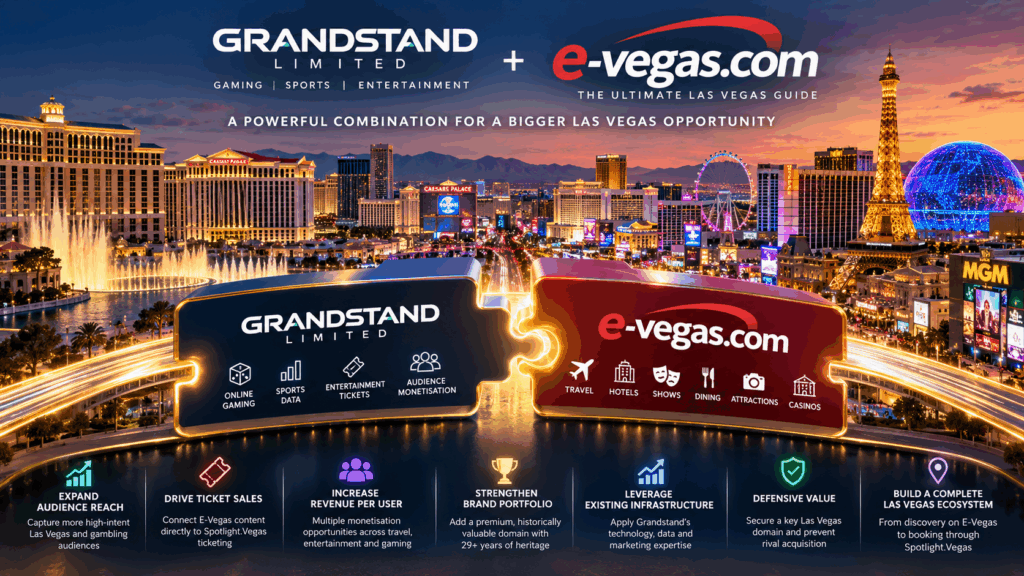
E-Vegas.com sits directly at the intersection of several businesses Grandstand already operates. It covers online gambling, casino content, Las Vegas tourism, hotels, entertainment, attractions, shows and news. More importantly, E-Vegas already promotes Spotlight.Vegas as a Las Vegas ticketing partner. An acquisition would therefore not require Grandstand to invent a relationship between two unrelated businesses. The commercial relationship and audience overlap already exist.
The question is not whether E-Vegas.com resembles Gambling.com. It does not need to. The more interesting question is whether E-Vegas could become a useful consumer-facing gateway into Grandstand’s expanding Las Vegas ecosystem while retaining a sufficiently distinctive identity to justify remaining an independent brand.
There are several reasons why the answer may be yes.
Gambling.com Group Has Become Grandstand — And That Change Matters
The first point is important because any analysis based on the Gambling.com Group of five years ago would miss what the company is attempting to become today.
In July 2026, Gambling.com Group formally became Grandstand Limited. The Gambling.com website remains one of its consumer brands, but the corporate organisation now describes itself as an intelligence layer spanning sports, gaming and entertainment. Grandstand’s current portfolio includes Gambling.com, Casinos.com, RotoWire, OddsJam, OpticOdds and Spotlight.Vegas, alongside technology used for advertising, audience monetisation, sports data and entertainment ticketing. The rationale for the change is explained in Grandstand’s own announcement of the corporate rebrand.
This distinction is relevant to E-Vegas because Grandstand is no longer looking exclusively at websites capable of referring online casino players. Its stated addressable market has expanded into entertainment, ticketing, data and broader audience monetisation.
The company’s own description of its partner solutions now specifically identifies “Entertainment and Tickets” as one of its principal product categories, delivered through Spotlight.Vegas.
That puts Las Vegas itself inside Grandstand’s strategic perimeter.
Spotlight.Vegas Fundamentally Changes the E-Vegas Equation
Grandstand completed its acquisition of Spotlight.Vegas on 1 September 2025. According to its SEC filings, the transaction consisted of an initial $8 million consideration, subject to adjustments, with potential additional earnout payments of as much as $22 million dependent upon subsequent financial performance. Grandstand’s SEC disclosure covering the Spotlight.Vegas acquisition explains the structure in detail.
The strategic rationale was unusually revealing.
Spotlight.Vegas was not acquired merely because it sold show tickets. Grandstand said the business provided another method of monetising the high-intent audiences already visiting its websites. Spotlight also expanded Grandstand’s relationships beyond digital gambling operators to include entertainment venues, attractions and land-based casinos.
When the acquisition was announced, Spotlight had relationships with more than 40 Las Vegas clients and its customers had purchased more than $30 million of tickets during 2024. Grandstand said it expected the business to generate at least $8 million of net revenue and $1.4 million of incremental adjusted EBITDA in 2026. Those figures and the company’s rationale can be found in the original Spotlight.Vegas acquisition announcement.
There was another particularly important statement.
Grandstand explained that it eventually intended to deploy Spotlight’s technology across other owned websites, specifically mentioning Casinos.com, and potentially use the platform beyond Las Vegas.
That creates the most obvious strategic rationale for E-Vegas.com.
Rather than adding a Las Vegas ticketing system to a broad international casino website and attempting to create a destination audience from scratch, Grandstand could potentially place its existing ticketing infrastructure behind a brand already explicitly dedicated to Vegas.
E-Vegas would become an acquisition channel.
Spotlight.Vegas would remain the transactional infrastructure.
Grandstand would own both ends of the journey.
E-Vegas Already Sends Visitors Towards Spotlight.Vegas
This is not theoretical.
E-Vegas already publishes Las Vegas entertainment content that promotes Spotlight.Vegas. Its existing Las Vegas monthly show guides describe Spotlight.Vegas alongside Expedia and Vegas.com as recommended booking providers, while other E-Vegas show content specifically promotes Spotlight ticket purchasing and its price guarantee.
An existing E-Vegas guide to Las Vegas shows and Spotlight.Vegas ticketing demonstrates how closely aligned the businesses already are. E-Vegas publishes the discovery content while Spotlight provides the booking destination.
Under independent ownership, a visitor can enter E-Vegas through Google, social media, news content or direct navigation, read about a show and then leave E-Vegas to transact with Spotlight. E-Vegas receives whatever commission is provided under its commercial relationship.
Under common Grandstand ownership, the economics could change considerably.
Grandstand would effectively own both the media property creating demand and the platform converting that demand. Affiliate leakage between the two businesses could disappear from the consolidated economics. Conversion testing could become more sophisticated. Spotlight inventory could be integrated directly into relevant E-Vegas articles. Prices, availability, showtimes and offers could potentially be populated dynamically rather than maintained editorially.
A visitor searching for a specific performer might consequently enter E-Vegas through an editorial page, compare the production, view current prices, choose a performance and complete the transaction through Spotlight infrastructure without encountering the normal discontinuity between publisher and ticketing platform.
That is considerably more valuable than simply owning another affiliate website.
E-Vegas Is Also a Historically Relevant Domain
There is another element that distinguishes E-Vegas from a newly registered affiliate domain.
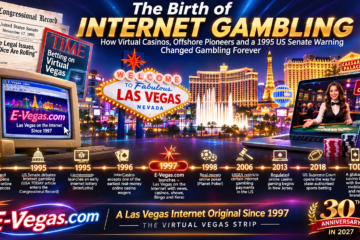
The E-Vegas name has documented commercial history dating back to the earliest years of the consumer internet. A United States Patent and Trademark Office publication relating to the original E-VEGAS mark records first use and first use in commerce on 14 January 1997.
Remarkably, the services specified in that historical filing included online advertising, providing information about Las Vegas entertainment events, and providing information about hotels and restaurants over computer networks. Readers can examine the original .
Those categories bear an extraordinary resemblance to the commercial opportunity being discussed almost thirty years later.
The historical registration itself should not be confused with a current federal trademark registration. Public trademark records indicate that the original registration was subsequently cancelled under Section 8 in 2008. should therefore form part of any intellectual-property due diligence rather than being represented as an active registration.
Nevertheless, the record provides something strategically useful that cannot simply be manufactured by registering another Vegas-related domain in 2026: independently documented commercial use of the E-Vegas name dating to 1997.
E-Vegas also maintains historical Las Vegas material, including contemporary travel writing from that period. Its modern examination of the provides another layer of evidence that the name was associated with actual Las Vegas publishing rather than merely sitting unused as an old domain.
For an acquirer building a portfolio of recognisable consumer brands, that history has potential brand value independent of immediate affiliate revenue.
Grandstand Has Already Demonstrated That It Values Premium Domains
Grandstand’s own corporate history provides another useful comparison.
The company acquired Gambling.com for $2.5 million in April 2011. It subsequently acquired Bookies.com and, in November 2022, purchased the Casinos.com domain before launching the website in 2023. These transactions are documented in Grandstand’s annual reporting on the development of its principal consumer brands.
That history is significant because it demonstrates that management understands the strategic value of memorable, category-relevant domains.
Gambling.com tells somebody exactly what the subject is.
Casinos.com does the same.
Bookies.com does the same.
E-Vegas.com operates on a similar semantic principle. It is short, recognisable and immediately evokes a digital version of Las Vegas.
It would therefore not be irrational for Grandstand to view E-Vegas as more than a collection of WordPress pages and affiliate accounts. The domain itself could function as a brand around which a wider Las Vegas digital property could be constructed.
The distinction is important when assessing value.
Content can be recreated.
A twenty-nine-year-old domain with a concise relationship to one of the world’s most recognisable entertainment destinations cannot be recreated in the same way.
Grandstand Explicitly Looks for Under-Monetised Digital Assets
Perhaps the most compelling evidence comes from Grandstand itself.
In describing its acquisition strategy, the company has previously said that its experience and technology allow it to acquire strong sub-scale or under-monetised websites and apply more established processes and technologies to them. The language appears in its annual reporting covering Grandstand’s strategic acquisition strategy.
That description is unusually relevant to E-Vegas.
E-Vegas does not need to be the size of Gambling.com for an acquisition to make sense. It only needs to possess assets that Grandstand believes it can monetise materially better than the present owner.
That difference between current earnings and buyer-specific earnings is where strategic acquisition value is created.
Grandstand has substantially greater negotiating power with casino operators. It has international affiliate infrastructure. It possesses advertising technology, data, conversion expertise, email infrastructure, paid acquisition capabilities and substantial engineering resources. It owns Spotlight’s ticketing platform and has direct relationships with Las Vegas entertainment venues.
If an independent E-Vegas earns £1 from a particular piece of traffic but Grandstand believes its infrastructure could earn £3 or £4 from the same user journey, valuing E-Vegas solely on its historical profit would miss part of the economic rationale.
The relevant number becomes the value of E-Vegas inside Grandstand rather than only the value of E-Vegas as a standalone JWK Digital property.
E-Vegas Could Become the Editorial Layer Above Spotlight.Vegas
Spotlight.Vegas is fundamentally transactional. Its strongest pages naturally concentrate on products that can be booked: shows, attractions, hotels and experiences.
E-Vegas can perform another function.
A destination publisher can capture users considerably earlier in the travel-planning process. Someone researching the best month to visit Las Vegas may not buy a ticket that day. Somebody searching for information about Caesars Palace, Formula 1, Fremont Street, Sphere, MGM Grand, Las Vegas weather, casino history or a forthcoming residency may nevertheless be several steps away from a commercially valuable transaction.
Editorial publishing captures that earlier intent.
E-Vegas currently maintains extensive Las Vegas entertainment coverage, including structured monthly show guides. Its Las Vegas shows section and individual resources such as its detailed Las Vegas shows in November guide demonstrate the type of informational content that can sit above transactional inventory.
That creates an opportunity to build a classic content-to-commerce funnel.
Discovery happens on E-Vegas.
Inventory comes from Spotlight.
Checkout happens through Spotlight technology.
Subsequent audience monetisation could then extend into hotels, attractions, gaming, restaurants, events or other Grandstand products where regulations and user consent permit.
Instead of Spotlight continually purchasing or competing for traffic in the open market, E-Vegas could provide another proprietary source of that demand.
Las Vegas Is Large Enough to Support the Model
The underlying market is hardly niche.
According to the Las Vegas Convention and Visitors Authority’s latest tourism statistics, Las Vegas welcomed approximately 38.5 million visitors during 2025. Those visitors generated approximately $50.8 billion in direct visitor spending and contributed to an estimated $80.9 billion overall tourism economic impact.
The same LVCVA dataset records approximately six million convention delegates, more than 44 million occupied hotel room nights and roughly 150,300 available hotel rooms.
Entertainment is a meaningful part of that economy. The LVCVA’s 2025 Las Vegas visitor statistics and frequently asked questions report that 21% of visitors attended a show, while the average gambling budget among visitors who gambled was $849 per trip.
For a media and commerce company, the significance is not simply the number of tourists. Las Vegas visitors make numerous purchasing decisions around the same journey.
They need accommodation.
They buy entertainment.
They visit attractions.
They gamble.
They eat in restaurants.
They attend sporting events.
They use transport.
They may purchase flights and packages.
A sufficiently authoritative Vegas publisher can therefore monetise the same visitor at multiple points without needing to transform into a travel operator itself.
That fits Grandstand’s broader objective of obtaining more value from each audience rather than depending upon one transaction.
E-Vegas Also Bridges Online and Land-Based Gambling
The E-Vegas proposition is unusual because it naturally spans two markets that are frequently separated by publishers.
One is Las Vegas as a physical destination.
The other is Vegas as an internationally understood shorthand for casino gambling.
The current consequently combines online casino information with Las Vegas travel and entertainment content. Its affiliate disclosure also states that the business may generate income from casinos, sportsbooks, hotels, ticket providers, travel companies and attractions. confirms that multi-vertical approach.
For Grandstand, that overlap could be valuable.
Gambling.com primarily occupies the regulated gambling comparison space. Casinos.com gives the group an exceptionally strong pure casino brand. Spotlight occupies Las Vegas transactions and experiences.
E-Vegas could sit between them.
A user interested in Las Vegas casino resorts could potentially move towards Spotlight ticketing.
A UK user interested in playing casino games online could move towards licensed gambling partners.
A visitor reading casino history could later become a hotel customer.
An entertainment visitor could become a newsletter subscriber.
That interconnected audience is potentially more interesting than another website aimed exclusively at “best casino bonus” keywords.
There Is Also a Defensive Acquisition Argument
Strategic acquisitions are not always about what the purchaser can build with an asset. Sometimes they are partly about preventing somebody else from building it.
E-Vegas.com is close enough to Spotlight.Vegas semantically and commercially that ownership by another well-funded gambling affiliate, ticketing operator or Las Vegas travel company could eventually create competition.
A rival owning E-Vegas could develop a show-ticket marketplace, build hotel integrations, target casino resort queries, develop a Las Vegas app or form relationships with competing ticketing platforms.
Grandstand already owns Spotlight.Vegas.
Owning E-Vegas would potentially provide the group with a second highly intuitive Vegas brand covering the editorial and discovery side of the customer journey while Spotlight concentrated on transactions.
That is not sufficient justification for an acquisition by itself, but strategic control can form part of a buyer’s calculation where domain supply is inherently finite.
There can only be one E-Vegas.com.
The News Operation Could Have Independent Value
Another interesting component is News.E-Vegas.com.
Rather than treating news merely as filler surrounding affiliate landing pages, Grandstand could develop the publication as a specialist Las Vegas news and destination media property. Entertainment announcements, casino developments, resort openings, celebrity residencies, Formula 1, Sphere productions, restaurant openings, major sporting events and Las Vegas business news all create continuous demand for fresh content.
That content has value beyond immediate affiliate conversions.
It can generate newsletter subscribers, social audiences, Google Discover exposure, backlinks, branded search, direct traffic and relationships with venues and public-relations teams.
Grandstand itself is deliberately reducing reliance on conventional SEO. In its second-quarter 2026 results, the company said non-SEO sources had grown to approximately two-thirds of marketing revenue.
That is particularly important to any E-Vegas acquisition thesis.
The correct strategy would not be to purchase E-Vegas merely for today’s Google rankings. It would be to use an established search footprint as the starting point for building a broader direct audience through email, social media, video, apps, communities, news and brand recognition.
Search Traffic Is an Asset — But Also the Biggest Warning
No serious acquisition analysis should ignore the risk.
Grandstand has recently experienced exactly the problem that demonstrates why SEO-derived valuations require caution. Its June 2026 interim reporting showed that UK and Ireland revenue fell substantially year-on-year, with the company attributing part of that decline to Google algorithm changes that reduced organic visibility. Grandstand’s June 2026 SEC filing provides the figures and explanation.
An acquirer should therefore not pay a large multiple simply because E-Vegas currently ranks for valuable queries.
Rankings move.
Algorithms change.
AI Overviews can reduce click-through rates.
Search behaviour evolves.
Competitors improve.
The more durable acquisition case lies in the combination of the domain, brand recognition, historical content, direct audience, backlinks, commercial relationships, editorial infrastructure and the ability to connect those assets to Spotlight’s transactional technology.
That is a considerably stronger proposition than “buy this website because it gets Google traffic.”
Why Buying E-Vegas Could Be Better Than Building Another Vegas Site
Grandstand could of course register another Las Vegas domain and build a publication internally.
Technically, that would be easy.
Commercially, it is a different proposition.
A new domain starts without history, without an established backlink profile, without indexed content, without existing search visibility, without historical material and without years of brand association.
Grandstand already demonstrated its willingness to purchase rather than build when it acquired Spotlight. Former CEO Charles Gillespie explained that the company had wanted to provide products such as tickets to Casinos.com users and determined that acquiring Spotlight was preferable to constructing an equivalent ticketing platform from scratch. That rationale was reported in coverage of the Spotlight.Vegas acquisition and Grandstand’s plans for the platform.
The same build-versus-buy calculation could apply at a smaller scale to E-Vegas.
The question for Grandstand would therefore be simple: how much would it cost, how long would it take and how uncertain would the result be to reproduce E-Vegas’s combination of domain, content, history and search presence internally?
The acquisition price only needs to compare favourably with that alternative.
Grandstand’s Acquisition History Provides Useful Context for Valuation
There is no responsible way to place a precise valuation on E-Vegas without access to its accounts, Google Search Console, Analytics, affiliate reporting, backlink profile, contractual relationships, databases, intellectual-property documentation and detailed traffic history.
However, Grandstand’s previous transactions provide useful context.
The company paid $2.5 million for the Gambling.com domain alone in 2011. It subsequently bought Casinos.com and Bookies.com. It agreed to consideration of between $37.5 million and $42.5 million for Freebets.com and related assets in 2024, according to its SEC disclosures covering the Freebets.com transaction.
These businesses are not directly comparable with E-Vegas, and their purchase prices should not be used as simplistic valuation multiples.
Spotlight provides another interesting accounting reference. Grandstand’s purchase-price allocation attributed approximately $1.55 million to Spotlight’s domain names and related websites and approximately $2.6 million to its acquired technology, while substantial additional value was allocated to goodwill. Those figures are available in the company’s financial disclosure following the Spotlight acquisition.
Again, that does not mean E-Vegas is worth $1.55 million. Spotlight included significant proprietary booking technology, commercial relationships and substantial ticket turnover.
What these transactions demonstrate is something narrower but important: Grandstand has repeatedly assigned meaningful value to domains, websites, audiences, content and technology when those assets fit its strategy.
What Might E-Vegas Actually Be Worth to Grandstand?
A credible E-Vegas valuation should be separated into standalone value and strategic value.
Standalone value would be determined primarily by verified profit, traffic quality, recurring affiliate income, direct traffic, backlinks, domain value, content assets and operating costs.
Strategic value asks a different question: what additional earnings could Grandstand create because it already owns Spotlight.Vegas, Gambling.com, Casinos.com, performance-marketing infrastructure and Las Vegas commercial relationships?
That second figure could be materially higher.
On public information alone, a seven-figure cash valuation cannot responsibly be asserted. Equally, valuing E-Vegas like an ordinary small affiliate blog would ignore the strategic characteristics of the asset.
An illustrative acquisition range in the region of £250,000 to £500,000 could be commercially defensible if due diligence verified meaningful organic visibility, clean backlinks, real revenue, assignable content rights and continued growth. A performance-based structure could potentially take total consideration materially higher if E-Vegas subsequently delivered substantial ticketing, gambling or advertising contribution under Grandstand ownership.
A transaction approaching or exceeding £1 million would become easier to justify only if the buyer could verify significant revenue, durable traffic, valuable proprietary content or a compelling amount of incremental Spotlight and Grandstand contribution.
This should therefore be viewed as an acquisition framework rather than an independent formal valuation.
Interestingly, Grandstand already has a preference for structures that solve precisely this uncertainty.
The Spotlight deal combined an initial payment with large performance-based earnouts. During discussions of the transaction, management described the approach as capital efficient because additional consideration would be paid when specified operating performance was achieved. The Spotlight acquisition structure and earnout methodology illustrates how Grandstand has approached exactly this type of risk.
E-Vegas could potentially be structured similarly on a much smaller scale.
The Sensible Integration Would Probably Preserve E-Vegas
The worst use of E-Vegas following an acquisition would arguably be to redirect the entire domain to Spotlight.Vegas.
That could destroy much of what Grandstand had purchased.
A more logical model would preserve E-Vegas as an independent consumer brand while integrating Grandstand infrastructure underneath it.
Editorial pages could continue to rank independently. Spotlight inventory could power show and attraction booking. Grandstand advertising technology could monetise appropriate inventory. Casinos.com or Gambling.com relationships could be used selectively where appropriate and compliant. Email and social audiences could be developed independently.
That creates multiple consumer entry points into one corporate ecosystem without forcing every customer through the same brand.
Grandstand already follows that portfolio model.
Gambling.com remains Gambling.com.
Casinos.com remains Casinos.com.
RotoWire remains RotoWire.
Spotlight.Vegas remains Spotlight.Vegas.
There is therefore little reason to assume E-Vegas would need to disappear in order to create value.
There Are Real Due-Diligence Questions
None of this means Grandstand should acquire E-Vegas without extensive diligence.
Domain ownership and chain of title would need verification. Historic and current trademark rights would need legal review. Image licences and contributor agreements would need examination. Affiliate agreements may contain change-of-control or assignment provisions. Traffic sources would need to be separated between organic, direct, referral, social, paid and automated activity.
Backlinks would need forensic examination.
Search Console data would need to establish which pages and queries actually generate commercial traffic.
Revenue would need to be reconciled directly against affiliate networks and partners.
Historical content ownership would need verification.
The News.E-Vegas.com subdomain would need its own technical and SEO assessment.
Grandstand would also have to determine whether E-Vegas overlaps excessively with existing Casinos.com content or whether the distinct Las Vegas positioning creates genuinely incremental demand.
These questions do not weaken the acquisition thesis. They determine the price.
The Existing Spotlight Relationship Makes E-Vegas Unusually Relevant
Perhaps the most interesting feature of the entire proposition is that E-Vegas is already commercially connected with the very Grandstand asset that would benefit most from owning it.
That changes the conversation.
If E-Vegas were merely another casino review website, Grandstand could compare it with hundreds of other affiliate acquisitions.
If it were merely another Las Vegas blog, its relevance to a gambling technology group might be questionable.
But E-Vegas combines both.
It covers casino gaming and Las Vegas.
Grandstand covers casino marketing and Las Vegas ticketing.
E-Vegas already promotes Spotlight.Vegas.
Grandstand owns Spotlight.Vegas.
That circular relationship is difficult to ignore.
From Affiliate Partner to Owned Distribution Channel
The simplest way to describe the potential transaction is therefore not “Grandstand buys another website.”
It is “Grandstand acquires an existing distribution partner.”
At present E-Vegas represents external media inventory from Grandstand’s perspective. Spotlight can receive customers from E-Vegas, but Grandstand does not control the publisher responsible for originating those customers.
Acquisition converts external distribution into owned distribution.
That provides control over editorial investment, conversion design, internal linking, technical infrastructure, ticket placement, remarketing strategy, content production, email acquisition and product development.
It also means money spent improving E-Vegas increases the value of an owned asset rather than merely enhancing a third-party affiliate relationship.
For a business increasingly focused on extracting more value from high-intent audiences, that logic is strategically consistent.
Why E-Vegas Could Be More Valuable to Grandstand Than to Almost Anyone Else
This is ultimately the central point.
The theoretical value of E-Vegas is not identical for every buyer.
A conventional SEO publisher might value the website primarily according to annual profit.
A domain investor might value the name.
A Las Vegas travel company might value the traffic.
A casino affiliate might value gambling conversions.
A historical publisher might value its archive.
Grandstand could potentially value all of them simultaneously.
It already has gambling monetisation infrastructure.
It already has Las Vegas ticketing technology.
It already has relationships with casinos and entertainment venues.
It already operates premium consumer domains.
It already has advertising and audience-monetisation technology.
It already has a physical Las Vegas operation. Grandstand’s Las Vegas office is specifically described as the home of the Spotlight.Vegas team, focusing on entertainment and ticket partnerships.
That produces a genuine strategic-buyer premium.
The same property can be worth more to a buyer possessing complementary infrastructure than to a buyer starting from zero.
A Small Acquisition Could Produce Disproportionate Optionality
Relative to Grandstand’s previous transactions, E-Vegas would potentially be a modest acquisition.
That may actually strengthen the case.
Grandstand committed as much as $30 million to Spotlight including earnouts. It paid tens of millions for Freebets-related assets and substantially more for Odds Holdings. Against transactions of that scale, acquiring an established complementary Vegas media property for a fraction of those amounts could represent relatively inexpensive optionality.
Grandstand would acquire another premium consumer-facing name.
Spotlight would gain an owned editorial funnel.
The group would strengthen its association with Las Vegas.
E-Vegas content could feed ticketing, casino, advertising and audience products.
News.E-Vegas could develop into a specialist destination publication.
The historical archive could strengthen brand authority.
And if the site grew substantially under Grandstand’s technology and commercial infrastructure, the value created could exceed what an independent owner could realistically extract from the same asset.
That does not guarantee an acquisition would succeed.
It explains why the proposition deserves serious examination.
The Broader Strategic Case
Grandstand’s evolution provides the wider context.
The company began as an online gambling performance-marketing business. It now owns gambling comparison brands, sports-data businesses, fantasy-sports publishing, advertising technology, audience-monetisation tools and Las Vegas ticketing infrastructure.
E-Vegas fits remarkably neatly between several of those categories.
Its history predates Grandstand itself.
Its name directly communicates a digital relationship with Las Vegas.
Its editorial scope covers gambling, casinos, shows, travel and entertainment.
Its existing content already promotes Spotlight.Vegas.
And Las Vegas itself remains one of the world’s largest concentrations of gambling, hospitality and live entertainment spending.
There is therefore a legitimate strategic argument that E-Vegas could become more valuable inside Grandstand than it is outside it.
The strongest acquisition case is not built around claiming that E-Vegas is already a giant business. It is almost the opposite.
Grandstand has repeatedly demonstrated an interest in acquiring assets where its technology, commercial relationships, marketing expertise and scale can potentially unlock additional value.
E-Vegas appears to possess many of the characteristics such a strategy requires: a memorable domain, documented heritage, established content, commercial intent, existing visibility, a Las Vegas audience and direct alignment with a business Grandstand has already spent millions of dollars acquiring.
Whether Grandstand ultimately considered E-Vegas worth £250,000, £500,000, £1 million or another figure entirely would depend upon confidential financial and technical due diligence.
But the strategic rationale for opening that conversation is substantially stronger than domain speculation alone might suggest.
For the company that owns Gambling.com, Casinos.com and Spotlight.Vegas, E-Vegas.com is not simply another name containing the word Vegas.
It could represent the missing editorial bridge between discovering Las Vegas and buying it.